

(Read more about the events preceding the Carnian Pluvial Episode in the article about The Great Dying: https://astropeeps.com/2022/09/27/the-great-dying/)
Half an eon of turmoil did our planet suffer until it settled down into a relative perpetuity of the evolution of species, safe from traumatizing factors that might shatter the very hope of life on Earth… or at least, this is how we, as short-lived creatures, like to believe, surviving in the great cosmic context of our Planet’s history.
There is no clear proof other than Earth’s upper-crust strata and fossils to shed some light into the five known (until now) massive extinction events that almost left the Blue Marble devoid of life.
The Ordovician-Silurian Extinction (440 million years ago)
(-> Read more here: https://astropeeps.com/2023/05/21/ordovician-extinction-or-how-the-first-terrestrial-plants-almost-killed-all-life-on-earth/),
The Devonian Extinction (365 Mya)
(-> Read more here: https://astropeeps.com/2023/09/22/the-devonian-extinction-no-clear-culprit-for-a-great-disaster/),
The Great Dying, as in the Permian-Triassic Extinction (252/250 Mya)
(-> Read more here: https://astropeeps.com/2022/09/27/the-great-dying/),
The Triassic-Jurassic Extinction (210 Mya)
(-> Read more here: https://astropeeps.com/2023/12/05/triassic-jurassic-extinction/)
and, finally, The Cretaceous-Paleogene Extinction (66 Mya)
(-> Read more here: https://astropeeps.com/2021/02/25/cretaceous-paleogene-extinction-the-chicxulub-event-and-the-fall-of-the-dinosaurs/)
have all managed to deviate life towards unexpected paths. Still, future research will most certainly prove the occurrence of several other episodes resulting into the rise and fall of our Planet’s species. And though the Carnian Pluvial Episode isn’t officially classified as an extinction event – as in the sixth one to be unraveled during Earth’s most recent half billion years – it is only because of the novelty of its discovery and the need of more scientific proof.

The Great Dying (252 million years ago) was probably triggered by a massive release of basalt flood magma in the Siberian Traps. Subsequently, a plethora of extinction pulses razed more than 90% of life on Earth, consequentially ending the Permian (298.9 to 251.9 Mya) – and thus the Paleozoic Era (539 to 251.9 Mya) – establishing the foundations of the Triassic, and thus the Mesozoic Era.
The Triassic (251.9 to 201 Mya), the shortest geological period of the Mesozoic (251.9 to 66 Mya), didn’t experience major shifts in Earth’s tectonic plates. Pangea remained pretty much the same supercontinent surrounded by the giant ocean, Panthalassa, and a shallow ocean, Thetis, on its eastern shores. Only 30 million years after the events described in this article will the landmass start to separate into Laurasia (north) and Gondwana (south). The vast continent was still arid and slowly recovering after the Permian extinction. Archosaurs emerged and radiated into several clades. One of these clades, the dinosaurs, would eventually rule the world. Yet during the Early Triassic, they were still modest in size, resembling modern day crocodiles, though able to stand on their back feet, yet still far from the well-known giant creatures that would roam the Earth during the Jurassic.
Therapsids, the leading group during the now-defunct Permian, suffered a major decline, though they had already evolved into numerous subgroups, and most important, into the first mammals.
Our world was still arid, hot, and mostly barren. Rain was unable to reach far inland into Pangea, and there are no known coal deposits from the Early and Middle Triassic, as it was impossible for large woodlands to survive in these harsh conditions. Plants were modest in size, poor in fiber, less represented by vascular plants and more commonly found as spore- and seed-ferns, horsetails and now-extinct seed-bearing shrubs, known as bennettilates.

Marine life witnessed a major shift in reptiles and predatory fish, new species of cephalopods, corals and plankton, more fit to adapt and survive the aftermath of euxinia and anoxia that had poisoned the oceanic waters during The Great Dying.
The Siberian Traps had now long been inactive, but there was no time for stable evolution, as by 234 Mya another supervolcano started erupting: The Wrangellia Traps.
The Triassic, as well as all other geological periods, is divided in a sequence of ages, coinciding with earth strata. Each of these strata stands as geological proof to what happened during a specific period of time on our planet, including flora, fauna, and climate stages. One of the characteristics of all five major known extinction events is that they all represent a rift between geological periods, or even geological eras, such as The Great Dying/Permian-Triassic Extinction Event, as the final chapter of the Paleozoic Era, and starting point of the Mesozoic. In this regard, The Carnian Pluvial Episode, as suggested by the name, occurred during the Carnian age, the first age of the Late Triassic. However, this two million years long rainfall did not dramatically influence the strata as to divide the Carnian into two separate ages. As mentioned before, there are very few details known about the changes that triggered the pluvial episode, but it is plausible that the entire Carnian Age, coinciding with the Carnian earth strata, to have witnessed perpetual turmoil in subsequent pulses.
Research on carbon levels in plant fossils by mid Carnian (approximately 234 Mya) show a massive intake in CO2, coinciding with the basalt flood magma deposits in the Wrangellia Traps, located in modern day Alaska and British Columbia. Although a supervolcano, the Wrangellia Terrane’s area is far smaller compared to the gigantic territory of the Siberian Traps that triggered the first major extinction pulse of The Great Dying.

But when it finally erupted, the Wrangellia Traps released large amounts of CO2, among other gases, into the atmosphere, prompting global temperatures to rise by 3 to 6° C. (Again, by far less dramatic than the rise in temperatures during The Great Dying.)
The sudden shift in global temperatures also led to a rapid rise in humidity, as the volcanic eruptions of the Wrangellia Traps lasted between five and six million years, with lava deposits amounting a 6 km in depth.
Warmer temperatures meant accelerated water cycles; faster water cycles on prolonged periods of time meant ever heavier accumulation of rain clouds. Thus, one million years after the Wrangellia Traps started erupting, there was enough humidity to penetrate the entire huge landmass of Pangea. In fact, geologists have discovered huge swamps, large river beds and massive coal deposits all over the planet during the 234 to 232 Mya time period, leading to the logical conclusion that this was not some random, local event, but a planetary episode of heavy rain that lasted for two million years. Leading to this event, Pangea, throughout the Early and Middle Triassic, remained a vast arid desert, with coastal rains unable to penetrate far inland. As a result, plants didn’t have the necessary nutrients to rise tall above the ground or become fibrous. Most animals adapted perfectly to this environment, remaining short, four-legged creatures that would only remain, such as most plants: close to the ground. Animals also didn’t develop teeth or use gastroliths for digestion, simply because they didn’t need to.
But when the rain began, it came in floods that would cycle throughout the year, for two million years. Remember, water vapor has a greenhouse effect, contributing to an increase in planetary temperatures, as the heat is trapped in the atmosphere and ground surface by the heavy clouds, unable to be released back into the cosmos to help cool down the planet.
With perpetual rain also came the proliferation and evolution of great, fibrous plants, leaving behind new coal deposits that had been absent now for almost 50 million years, as the arid climate of Pangea, up to the Carnian Pluvial Episode, did no longer allow the existence of lush marshlands and forests, that had covered the land during the Carboniferous and the first ages of the Permian.
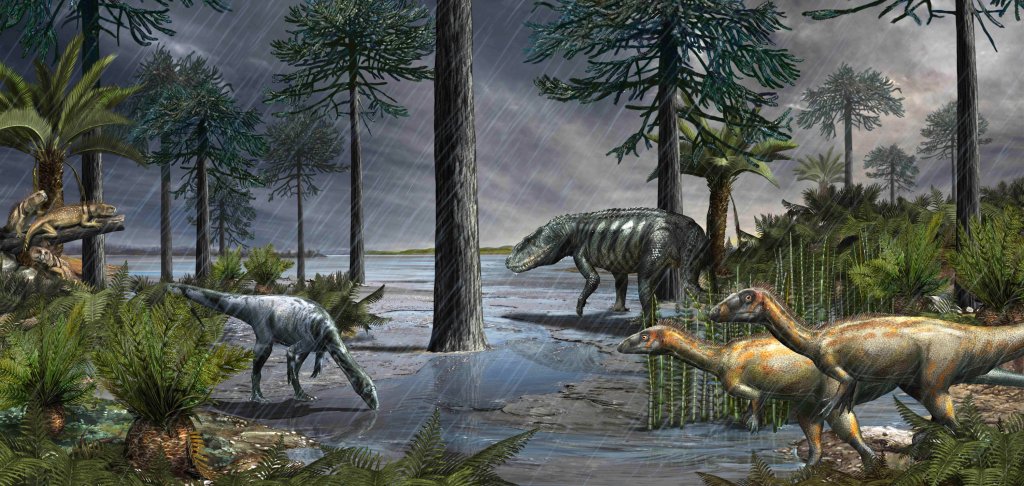
Most synapsids and sauropsids were unable to adapt to this new humid environment, and with the size increase of plants, they starved to death, as they were unable to digest the fibrous material, or reach the leafy tops of these newly emerged trees.
And so, dinosaurs became the new rulers of our Planet.
A small clade of the archosaurs till the Carnian Pluvial Episode, dinosaurs only account for less than 4% of all animal fossils up to 234 Mya. By the end of 232 Mya, the same dinosaurs account for more than 90% of all discovered animal fossils. The proliferation of fibrous plants (including the very first conifers on Earth) was a calamity for most animals, with legs too short to allow them to stand in an upward position. Dinosaurs, on the other hand, had already adapted to standing above the ground from the beginning of Early Triassic. Some were herbivores and could easily feed from these new leafy trees, other were predators that could now take advantage of a decaying food chain, of animals that were starving under the new climatic conditions on Earth.
The result: The Carnian Pluvial Episode was a disaster for most animals, both sea and land, but it set up the optimal evolutionary conditions for dinosaurs to become the dominant species on Earth for the next 170 million years.

As time passed, coal-forming trees stored the CO2 released by the Wrangellia Traps as coal deposits, thus purifying the atmosphere. Global temperatures cooled down and the continuous rain disappeared. The climate reverted to its pre-Wrangellia Eruption stages, and Pangea turned back into a vast desert.
But Earth was ready to remodel its tectonic features and, by the time the Triassic ended, Pangea fractured into Laurasia and Gondwana, opening the path towards the Jurassic…
… and staying true to itself, Earth did so in a brand new and massive extinction episode, that killed 76% of life on the Planet: The Triassic-Jurassic Extinction Event.
– Roman Alexander


 ASTROPEEPS.COM
Leave a reply to L'evento pluviale Carnico, cioè quando piovve per quasi due milioni di anni. Cancel reply