

On the morning of October 30, 1961, the Soviets detonated the staggering 27-ton Tsar Bomba on the Arctic island of Severny. To this day, the blast yield of 50 megatons TNT crowns the thermonuclear weapon as the most powerful, most destructive ever to be created by man. The mushroom cloud resulted by the detonation rose beyond the stratosphere, to a height of 67 km, with a shockwave circling the Planet three times, with a seismic wave circling the planet three times, with atmospheric pressure waves recorded in New Zealand, with shattered houses, rooftops, and windows up to 1000 km away from ground zero.

This photo of Tsar Bomba’s mushroom cloud was taken 161 km away from the site of the blast.
While the Tsar Bomba was a clean and controlled human experiment, inflicted in one of the most remote areas on Earth, anything one hundred-, ten- or even five times larger than the Soviet nuclear weapon would have caused total mayhem to several inhabited areas in Northern Asia and Europe. Such a blast would have turned into a catastrophic historical event for all Arctic Ocean coastal countries in Eurasia.
Still, the Tsar Bomba is nowhere near any of the six catastrophic events that have swiped our planet, almost sterilizing it entirely. One in particular, the asteroid that caused the Chicxulub Event, was at least 9 million times the equivalent of the aforementioned thermonuclear bomb, abruptly ending the Cretaceous 66 million years ago, thus opening the Paleogene period.
Evermore toxic planet – Super volcano in cahoots with super asteroid
By the fall of the Jurassic and the dawn of the Cretaceous, 145 million years ago, Earth still had one massive continent, barely holding it together before the split into the continents covering the planetary surface today. The cooling trend of the global climate, emerged during Late-Jurassic, eventually halted, then witnessed an overturn during the second period of the Cretaceous, into a stable, warm climate all around the globe, triggering the melting of the polar caps, and an increase of ocean-levels by 200 m compared to current times, leaving only 18% land above sea level. Vegetation and fauna began to proliferate, the percentage of atmospheric oxygen rose to 30-32, while under the shadow of the dinosaurs, mammals were still struggling to evolve, buried beneath the constant danger they were exposed to, living mostly underground and in caves.
The Cretaceous lasted for almost 80 million years, a time period that saw no major cataclysmic event to disrupt life on the planet. The dinosaurs, emerged in the Late-Triassic, some 243-234 million years ago, continued evolving into new biological species, from early archosaurs to ever more sophisticated species, such as the neornithine birds, the sole dinosaur group that managed to survive the Chicxulub Event.
66,25 million years ago, this exceptionally long and stable timeframe in our planet’s history was all of a sudden struck by a first global disaster: The Deccan Traps.
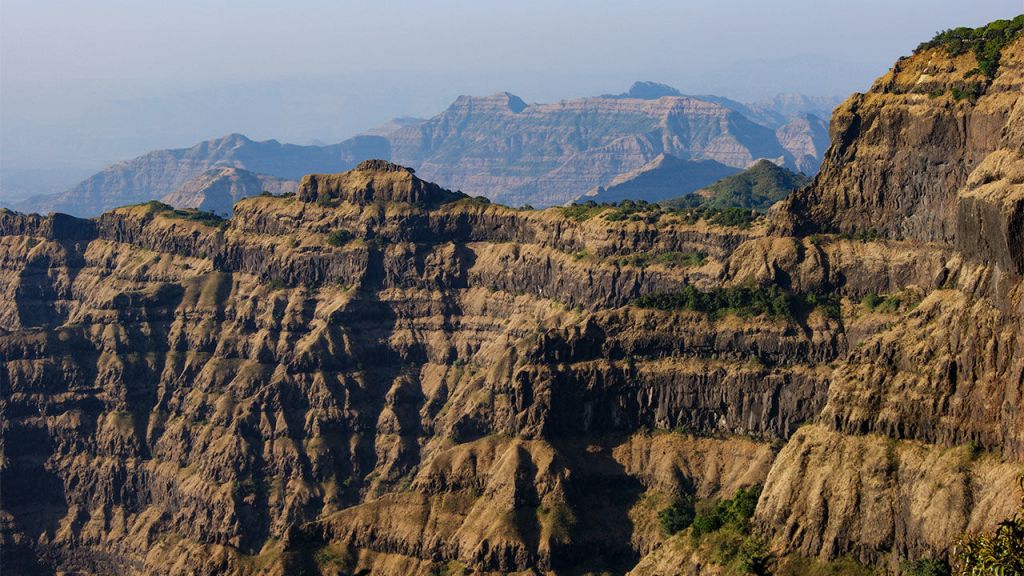
Deccan Traps in India
Spanning over an area of almost 1,500,000 km2, the largest super volcano on the planet, located in the west-central Indian subcontinent, started erupting. And it didn’t stop for 30,000 years. Constant release of unimaginable quantities of volcanic gases, particularly sulfuric dioxide, into the atmosphere contributed to less sunlight exposure, leading to a global drop in temperatures of 2⁰C. There is no doubt life on Earth was notably affected, as atmospheric oxygen levels also dropped by around 2%.
However dramatic the Deccan Traps might have been for the Northern Hemisphere, the Chicxulub Event, on the other side of the globe, trumped it completely, into one, if not the most, literally unfortunate disasters to have ever occurred on Earth.
The asteroid and the nuclear winter
The asteroid that impacted Earth 66 million years ago, ending the Dinosaur Era, was at least 10 km in radius (20 to up to 81 km in diameter). To put it into perspective, the Apophis asteroid, we fear so much, grazing Earth’s orbit on April 13, 2029, is 185 m in radius. What are the chances for us as a species to survive if the Chicxulub asteroid would hit the planet today? And what were the chances for the dinosaurs to survive, given the Chicxulub asteroid would have hit the planet almost anywhere else except for the Yucatán Peninsula 66 million years ago? Slim, but survival would have been plausible, and it would be plausible for us as well, however dramatic the extent of the catastrophic consequences of such an event.

Artistic depiction of the Chicxulub Crater
There are several data suggesting details of the impactor and corresponding event 66 million years ago. We know it was a rocky asteroid abundant in iridium. The geological layers related to the Cretaceous-Paleogene transition are rich in iridium, a metal so rare on our planet, yet so commonly found in the entire geological layer of the impact crater in the Yucatán Peninsula. We know the asteroid had a velocity of 25 km/s when it hit Earth at a 60⁰ angle. But more important, we know the Yucatán Peninsula was one of the worst places for an impactor to collide with the planet. Shallow seas and volatile materials in the crust, combined with an asteroid the size of a large city, was the perfect scenario for a global disaster. Almost anywhere else on Earth, land or sea, the impactor would have caused far less damage and cataclysmic consequences.
When the asteroid hit the Yucatán Peninsula, it created a crater 100 km wide and more than 30 km deep. Due to the kinetic energy released, water was instantly vaporized together with all rocky materials in the upper layers of Earth’s crust. Molten and solid debris in the subsequent layers were blown into the atmosphere, up to the lower orbit of the planet. A 12-magnitude earthquake shook the impact area, while magnitude 9 earthquakes hit every single spot of the planet. A 100 m megatsunami swiped out the coastal area of four continents, thousands of kilometers away from the crater, submerging the land. Every living organism, plant or animal, on a surface encompassing all modern Mexico and Southern USA was turned to ash, moments after the impact. And this was just the beginning.
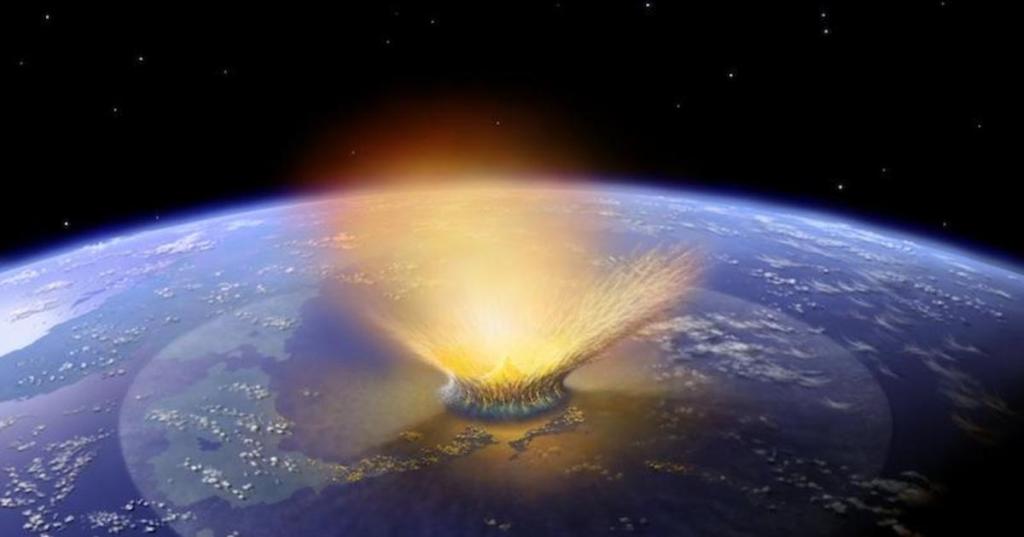
Artistic depiction of the Earth’s crust being vaporized by the kinetic energy released by an impactor the size of the Chicxulub Asteroid
Earth was now engulfed in a toxic atmosphere rich in vaporized water and rock, creating an immediate greenhouse effect. Material blown into the atmosphere started falling back to the planet’s surface, bombarding land and sea. Rock blown into the lower orbit fell back, impacting Earth with the force of a nuclear weapon per hit, some just kilometers apart from each other, vaporizing even more water and rock into the atmosphere. The entire planet turned from the once green, Cretaceous vegetation, with flowers that were just beginning to spread and diversify, to a gray, fiery inferno, surrounded by oceans in turmoil, hitting the land with tsunami waves.
Eventually, the atmosphere started cooling down, leading to yet another disaster: the spherules. Remember all the vaporized material caused by the asteroid and the following debris impacts? It started clumping up in the atmosphere, once the air began cooling down, then started falling back on Earth, at distances less than 10 km apart, sterilizing everything in its path.
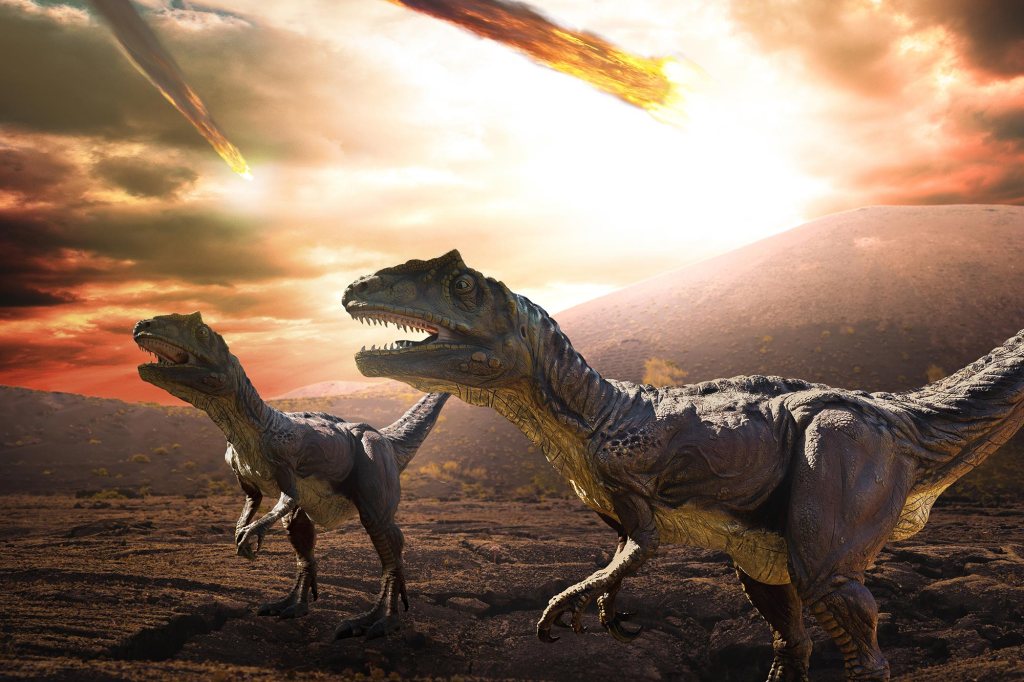
By this time, if there were any living dinosaurs left on Earth (except for the neornithine birds), and there were probably still some alive on both land and in the sea, they started dying out of starvation.
During the next decades, light from the Sun continued to be obliterated by a thick atmosphere, rich in carbon dioxide, resulted from the vaporization of carbonate rocks during the initial impact. Phytoplankton, dependent on sunlight, completely died out, disrupting the food chain and thus leaving other animals to starve, creating a death spiral for marine life. On land, all vegetation was either wiped clean by the initial and subsequent impacts, or it died out completely due to the lack of sunlight. No animal on Earth over 10kg managed to survive the Chicxulub event, while more than 75% of global species irremediably disappeared. The few animals that managed to survive, did so, by hiding underground in an everlasting fight for survival for the progressively scarce resources available to them and fresh water turned toxic almost everywhere around the globe.
Paleogene revival and the rise of the mammals
To loosely paraphrase an over-the-top platitude: one’s asteroid is another one’s treasure. The mass extinction caused by the Chicxulub impactor was a major disaster for all life on Earth, whether it did or did not survive it. But in the end, it set the stage for the evolution of mammals and the dawn of modern man, 66 million years later. While mammals first appeared 210 million years ago, during the Late-Triassic, further evolving during the Jurassic and the Cretaceous, our planet offered a very unfriendly setup for this group to develop, as the top of the food chain was clearly dominated by the much larger dinosaurs.
As a dominant species, dinosaurs roamed the Earth for an unimaginable amount of time, almost 200 million years, with no further acquired abilities except for primary needs. Without the Chicxulub impactor, humans might have never appeared, radio signals would have never escaped the boundaries of our skies, nowhere on our planet would the sound of wind on Mars be broadcast as a major technological achievement, and, most importantly, there would have been no one to truly appreciate and discover the miracle of living on our Blue Marvel.
— Roman Alexander


Leave a Reply