
In order to answer these questions, I need to give you, the readers, some additional info in order to understand the concept of gravitational lensing.
The gravitational lensing effect is first of all one of Albert Einstein’s predictions on the general theory of relativity. To put it in simple terms, lensing is the bending of light by mass.
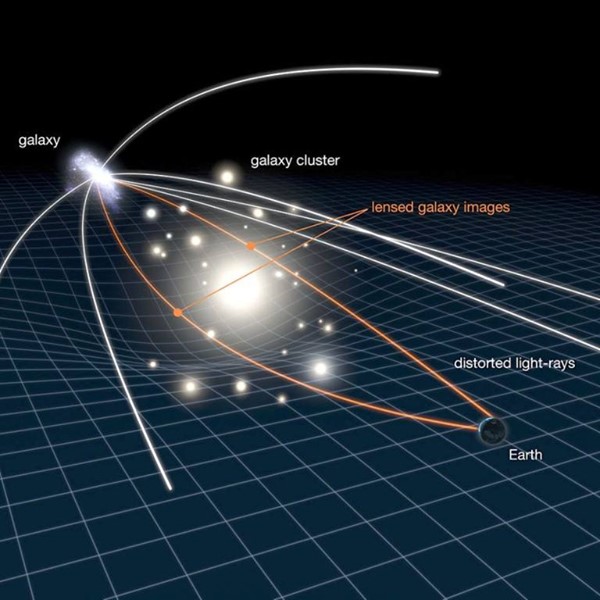
Let’s assume a ray of light passes in close proximity to an object (galaxy or cluster) with a huge mass. The gravitational field of such objects is powerful enough to bend light and refocus it. The more massive the object, the greater the light bending. There is however something massive enough surrounding all galaxies. We cannot see it, but we know it’s there, because it has mass: dark matter. I wrote a post about a week ago about dark matter and one of the things I described was its lack of interaction with light (hence the dark/invisible part). Dark matter can however bend light because it has mass and gravitation. Now, when we look through our telescopes in space we see galaxies or galaxy clusters, but the light coming from these systems may be bent by the gravitational power of dark matter, hence the lensing effect (take a look at the graph I’ve attached, it shows how light is bent by massive objects. Imagine that all the galaxies between the distorted light rays are also surrounded by dark matter, that also has mass and gravity.)
The effects of gravitational bending is the distorted image we see though our telescopes. Because of the lensing effect, galaxies and clusters may appear elongated and distorted. This is actually the answer to the last question. These galaxies are peculiar first of all because of this gravitational effect on light. The black and white image I’ve attached shows the gravitational lensing effect on Abel 2218 Galaxy Cluster. We see these deformed, elongated and curved images of various galaxies in the cluster, though in reality they have regular spiral or elliptical shapes, therefore, there is probably nothing peculiar about them at all.
Gravitational lensing also has its upsides as it can show the amount of dark matter present in space between our telescopes and the galaxies or galaxy cluster.
I will write a post tomorrow about a book (the absolute best book in my opinion) that talks about dark matter, as it might explain many objects and effects, such as gravitational lensing, dark matter or dark stars. – Roman Alexander
Here is a link to a list from Harvard of gravitational lens systems:
https://www.cfa.harvard.edu/castles/
(The question was originally asked by Gary Wood from The United States of America)


 ASTROPEEPS.COM
Leave a reply to Donna H Cancel reply