If someone asked me what my favorite planet in the solar system is, I immediately think of Jupiter. Besides being the largest planet, it has also shaped the entire topology of the solar system and will outlive the Sun by billions, if not trillions of years, without changing much from the state we can currently observe it in.
We – myself included – are so used to our own planet that we fail to remember how out of the ordinary it is compared to the rest. Earth has the highest density out of all the objects in the system, it has a thick atmosphere and is the only one with liquid oceans on its surface, and… we have the Moon.
There is a pre- and historical human fascination for our natural satellite, while from an astronomical perspective, Earth and the Moon almost resemble a binary system. In fact, nowhere else in the entire solar system do we encounter a moon as large as our own, when compared to its parent planet. Both Jupiter and Saturn have moons larger than our own satellite, yet they appear as a speck of dust next to the gas giants they revolve around. The Moon, though only the fifth largest natural satellite in the system, has a staggering diameter of 27,27% (3,474.2 km) of its parent planet’s diameter, compared to Earth’s 12,742 km. But remember, Earth is denser than any other object in the solar system. We might think about Pluto and Charon, with the latter measuring more than 50% of Pluto’s diameter. Charon is also widely denominated as Pluto’s largest moon. Problem is, it isn’t a moon and it doesn’t orbit Pluto. Both these objects wobble around each other, with Pluto far from being massive enough to lock Charon into an orbit around Pluto’s gravitational center. They are in fact a binary system of two dwarf planets orbiting a gravitational center located between the two objects.
Charon equals 12.2% the mass of Pluto. The Moon… 1.2% the mass of Earth. While it affects our oceans, seasons, plate tectonics, Earth’s rotation about the axis and Michael Jackson’s Thriller video, the Moon has no effect on the orbit of its parent planet around the Sun. In fact, it is locked in a synchronous rotation with Earth, always facing away one of its sides from our skies.
The inner planets are far less accompanied by natural satellites in regard to the four beyond the Asteroid Belt. Mercury and Venus completely lack any moons. Mars has two, very small moons, Phobos and Deimos, most probably captured from the asteroid belt. Due to the difference in size and density, Phobos, the largest moon, with a surface area of a large city (22x27x18km) will be torn apart by Mars’ tidal deceleration, eventually crushing on the planet’s surface or disintegrating into a ring around the Martian sky. Deimos, far smaller in size (15x12x11km), will slowly drift away into an ever growing orbit around Mars, until it will completely escape the gravity of its then former parent planet, driven away by Mars’ tidal acceleration.
Then there’s Earth, a planet like no other, with a Moon like no other among the inner objects of the solar system. Not only is the Moon massive in size compared to its parent planet, it is also a part of its parent planet. Literally!

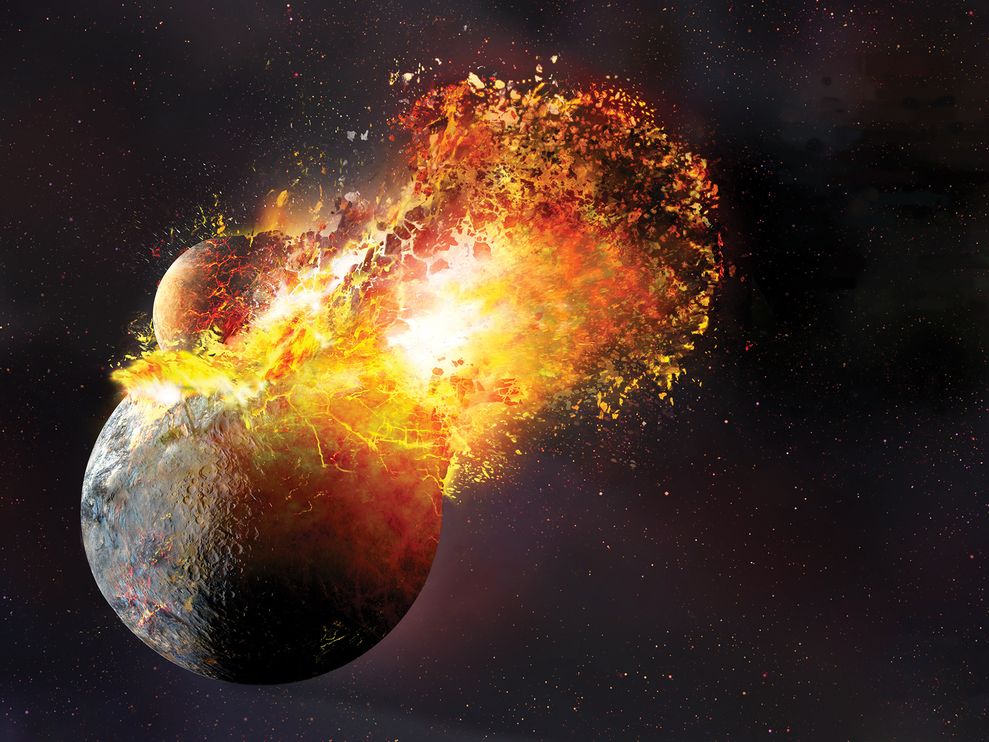
Artistic impression of Theia colliding with Earth
The Giant Impactor – The Birth of Our Moon
Soon after the formation of the Solar System, the dust covering the area closer to the Sun started to coalesce into small asteroids, turned to larger ones, turned to planetesimals. The inner system was far more chaotic and densely populated than we can ever imagine today. We could fit the entire Proxima Centaury system into Mercury’s orbit, yet we have only four, modest, rocky worlds, spaced far away from one another, between the Sun and the Asteroid Belt, on a radius of almost half a billion km. What caused this cataclysmic depopulation of the inner solar system? Jupiter! I have already written a couple of times before about the inward spiraling of the gas giant towards the Sun, right in the beginning of the Solar System, till Jupiter got pulled back by the formation and subsequent gravitational pull of Saturn. The impact of the very first gas giant on the inner planetesimals reshaped the topography, affecting the formation and evolution of each single remaining planet. Earth included.
Thanks to the Apollo missions, it was discovered that the material collected from the Moon has the same isotopic signatures as the rocks on our planet. Unlike many other discrepancies between parent planet and natural satellite, except for some few question marks, both the Moon and Earth seem to be highly linked to one another from a chronological and chemical point of view.

Artistic impression of Theia colliding with Earth
Closely following the formation of the solar system, 60 to 100 million years after the ignition of the Sun and most probably due to Jupiter’s erumpent motion towards the star, a Mars-sized planetesimal, Theia, collided with a then proto-Earth, from a sharp angle, almost pulverizing the planet. The inner and incandescent cores of the two bodies merged, while the aftermath of the gigantic impact crater spewed unimaginable amounts of molten material into Earth’s orbit. For a couple of weeks to a few months, Earth was surrounded by an impressive ring system of molten rock. Some of this material fell back on our planet’s magmatic surface, though most of it clumped together to form the Moon during the next millennia.
It is believed that Theia collided with Earth at an approximate 45 degree angle, with a velocity of 4km/s. The cores and some of the mantle of the two planetesimals merged, while the molten surface on the spot of impact was thrown into orbit, part within the Roche limit, part outside of it. It took years for the material outside the Roche limit to form the Moon. A second satellite, in a Lagrange point of the Moon also formed along. However, being far smaller in size, it eventually disintegrated on the far side, of a then still incandescent and molten object, orbiting Earth.
The Theia theory, explains both our planet’s and satellite’s features. A giant impact added to the mass of Earth, turning it into the largest terrestrial planet and also into the densest object of the solar system. It might also explain the tilt of the Moon’s orbit on Earth’s orbit around the Sun, though, in all honesty, the late heavy bombardment has much more to do with the lunar inclination around our planet’s equator.
Soon after its formation, the Moon was orbiting Earth at an approximate distance of only 25.000km away, compared to the current 384.400 km, appearing 14 times larger in the sky compared to our day and age. If today we see the cosmic recording of billions of years of asteroid bombardment on our Moon’s surface, back in the beginning, the giant disk on Earth’s sky was just a homogenous red, slowly turning to orange, then yellow, then the greyish white we see today, as the molten rock started cooling on the surface.
Back then, both planet and its moon used to spin around their own axis. It took more than 100 million years for Earth to lock the Moon into its synchronous rotation, and it took the Moon 4.5 billion years to slow down Earth’s spin around its axis from a 4h to a 23h and 56min long day. The reciprocity continued with the tidal forces exerted by both objects on one another. While we know about the tidal bulges perpetrated by the Moon on our oceans, Earth’s tidal forces also affect the Moon, slowly pushing it away into an ever growing orbit.

Lunar surface
Late Heavy Bombardment
During the following half a billion to 700 million years after the giant impact between Theia and Earth, the outer Solar System got to have its own makeover. The birth of Neptune and Uranus, and their realignment into their current orbits (for further information, see my article: Neptune’s Triton – A Dwarf Planet, Lost to an Ice Giant) triggered one of the most dramatic events in the history of the system, with Neptune’s migration into the Kuiper Belt and the subsequent late heavy bombardment.
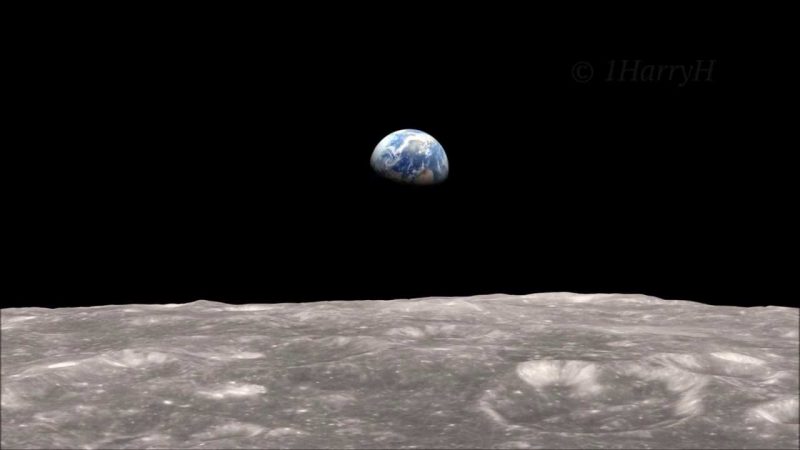
If we look at our Moon, it’s like observing a historical map of cosmic scars from impact craters and violent commotion. The tilt of the orbital plane of our satellite in respect to Earth’s orbital plane at the equator is off by 5 degrees, when in fact it should be perfectly aligned. Neptune’s aggressive migration into the Kuiper Belt put in motion a torrent of asteroids and comets, possibly even dwarf planets, rushing towards the inner solar system, into the Sun and the four terrestrial planets. Most impactors on our binary planet-moon-system hit Earth, due to the far larger gravitational pull. And it is gravity that erased the traces of these impact, while the Moon kept track of some of them to our present day.
The late heavy bombardment might have also triggered the increase in quantity of water on Earth and the presence of a fairly large amount of water beneath the lunar surface. It was also responsible for the appearance of bacterial life on our planet. While the Moon is too small to hold on to an atmosphere and to have a magnetic field, generated by the friction of an iron core against the liquid mantle, Earth was already shaped and equipped with every necessary trait for life to flourish on its surface, oceans and atmosphere.
If life appeared around oceanic thermal vents, the late heavy bombardment was responsible for it, by contributing to the amount of water on Earth.
If life appeared through panspermia, from an asteroid originated from the crust of Mars following an impactor on the Red Planet, the late heavy bombardment was responsible for it.
As for how exactly life appeared, whether its origin is on Earth or Mars, we still don’t know. For now, we have no idea what exactly can push chemistry to turn into the most primitive life form we know of.

The Moon
Current Past and Future Present
The next few billions of years, the Moon slowed down Earth’s rotation about its axis and slowly moved away into a 27-day orbit around the planet. And it will continue to do so. It will take our cosmic companion another 50 billion years to finally stabilize into a 47-day orbit around Earth. Or will it?
Our aging Sun will eventually exhaust the hydrogen fuel in its core, bloating into a red giant at least 100 times larger in volume. Its outer layers of heated hydrogen and helium gas will disintegrate Mercury and Venus, probably reaching the orbit of our planet, swallowing it as well into a cataclysmic doom. But as the Sun grows old, its luminosity increases. We don’t need to wait for 5 more billion years for our star to sterilize Earth into a wasteland or to destroy it, as it will already have done it in 1.2 billion years, when the Sun’s luminosity will have increased by 12%, making it impossible for life to exist on the surface of our planet, that is: including bacteria and tardigrades. Earth, just like its moon, will become barren much sooner than you could have imagined.
The agonizingly slow death of our star as a red giant will last for a billion years, progressively losing its outer layers of gas into a planetary nebula, as it cools down due to the decrease of activity in the core, fusing ever heavier elements till it will become a compact incandescent white dwarf, made almost entirely of carbon. An Earth-sized diamond as a dim reminder of a former yellow dwarf.
Our dying Sun might never reach the orbit of our planet. Earth and its Moon might still survive the outcome of a parentless solar system, but there won’t be anything left on Earth with the ability to appreciate or be fascinated by the Moon and its very long history around its planetary companion.
– Roman Alexander
 ASTROPEEPS.COM
Leave a comment