
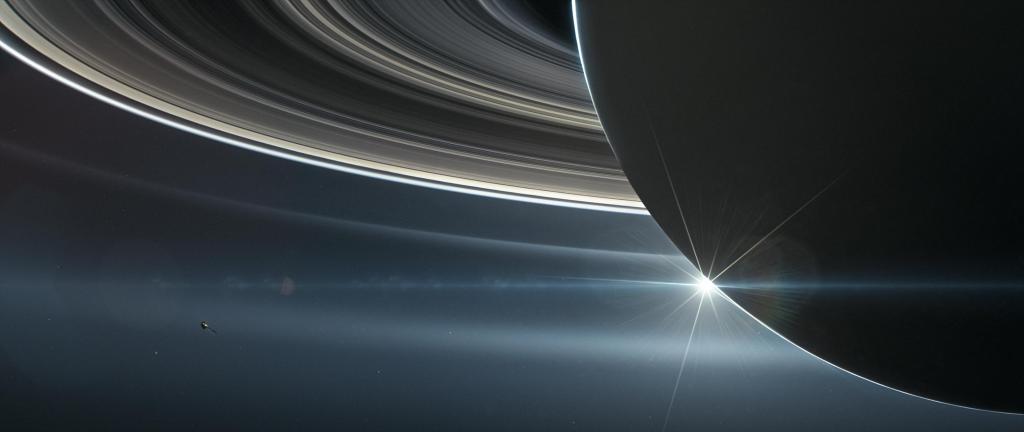
A couple of weeks ago, I wrote an article on planet J1407b with a ring system 90 million km in radius, 640 times larger than Saturn’s. Some of my readers have asked me how it is possible for a planet to exert such gravity upon space debris, mostly ice particles, organizing and spreading it to a ring system of 180 million km in diameter.
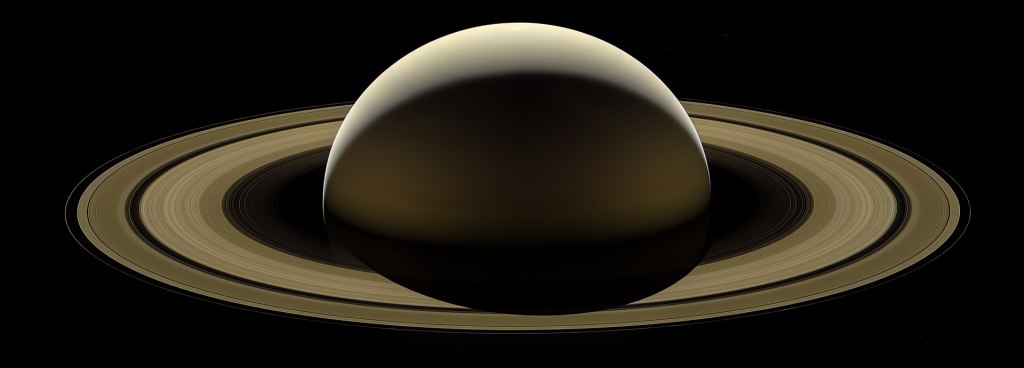
First, let’s take a step back and see what makes Saturn hold its rings together. Gravity! That’s pretty much it. However, consider that all particles are in fact freefalling towards Saturn, just like the ISS is continuously freefalling towards Earth. On the other hand, the massive amount of particles, each exerting its own small gravitational force, is in a continuous collision causing the particles to spread out. It’s a tug of war between opposite forces. And since every object in space, however small or large it is, has its own gravitational field, there are also Saturn’s shepherd moons leveling the rings and keeping them in place. Our Lord of the Rings has several, including the couple Epimetheus and Janus for the A Ring, Pan for the Encke Gap, Daphnis for the Keeler Gap and Prometheus for the F Ring. As all of you know, Saturn isn’t the only planet in the Solar System with rings around it. Jupiter, Uranus and Neptune all have rings, though far less visible than Saturn’s, and all have shepherd moons leveling the rings orbiting these large gaseous bodies. Shepherd moons are in fact aggregates of the particles orbiting a planet. As said earlier, when particles collide they spread out, though sometimes they fuse together to form larger icy bodies such as these shepherd moons that are also responsible for the gaps between the rings.
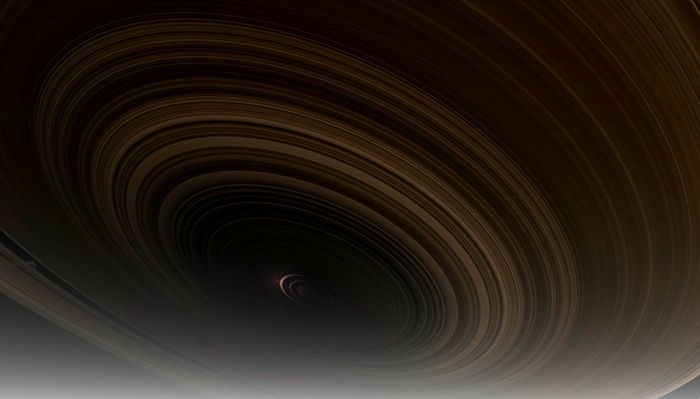
Now let’s go back to what was [in such an intellectual manner] asked in the title of this article: J140b. This exotic planet with its enormous ring system is between 13 and 26 jupiter masses. Furthermore, we aren’t quite sure if J140b is a planet or a brown dwarf, as it can easily be both due to its high mass. Before we ask ourselves how a planet could possibly hold together a 90 million km radius ring system, we need to know that we cannot truly compare J140b to Saturn. Saturn is 95 Earths in mass; J140b is between 4134 and 8268 Earths in mass! And if you’re still not convinced about the gravitational pull of big mamma J140b, consider this: S/2003 J 2, Jupiter’s outermost satellite orbits the planet at an average distance of more than 28 million km; Jupiter’s mass being at least 13 times less than J140b’s. As for the shape and regularity of the rings, we can only compare Saturn and J140b aesthetically, as Saturn is a mature, evolved and balanced system, kind of like a cougar planet, while J140b is very young with its rings due to amass into future moons that will probably compress the outermost rings into satellites, leaving only the particles closer to the planet as rings, if any at all. – Roman Alexander
(This article was requested by Navindra Roopnarine from Trinidad and Tobago and Amit Raka from India)
 ASTROPEEPS.COM
Leave a comment