

Continuing our immersive journey through the secrets of the universe, we stumble upon TrES-2b, 750 light years away from Earth and orbiting Kepler-1 star (also denominated as GSC 03549-02811, TrES-2 A or TrES 2 parent star) inside the Draco constellation.

Like most exoplanets discovered during the past decades, TrES-2b (discovered by the Trans-Atlantic Exoplanet Survey on August 21, 2006 and confirmed two weeks later) is a hot jupiter with around 1.2 Jupiter masses, orbiting its star at only 5 million km away. What makes it interestingly unique is its capacity to massively absorb light. In fact, TrES-2b reflects less than 1% of the light reflected on it from Kepler-1 star, appearing to be pitch black with a slight reddish halo around it.
There are some explanations to why this exoplanet is the darkest known planet out there. Our own gas giants, Jupiter and Saturn, are populated by reflective clouds in their upper atmospheres, each reflecting more than a third of the light they receive from the Sun. TrES-2b on the other hand is a super-heated monster, reaching atmospheric temperatures of almost 1000 degrees Celsius, being mantled by gaseous potassium and sodium clouds that absorb almost all the light. It has also been suggested that its clouds contain amounts of gaseous titanium oxide and vanadium, though it’s arguably impossible that such heavy compounds could exist so high in the atmosphere.
This (almost) pitch black exoplanet orbits a yellow main-sequence star very similar to our own Sun. However, TrES-2b, though larger in mass than Jupiter, is tidally locked to its star. During transit in front of Kepler-1, there are slight variations in brightness, slight being an overstatement since these changes are just six parts per million.
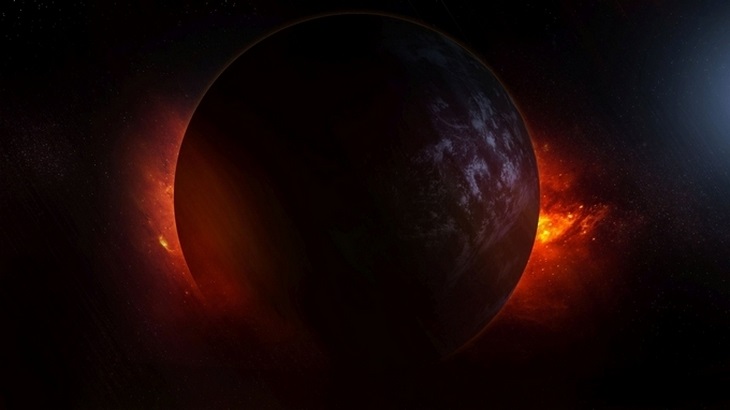
For now, the darkness of TrES-2b remains an unsolved issue, since there are no chemical explanations to what causes the huge amount of light absorption. Mercury for instance, being a rocky planet almost devoid of any atmosphere, still reflects 10% of the light it receives from the Sun. Our current computer models suggest that a hot jupiter could go no lower than 10%, as these planets, however hot they are, have reflective clouds in their upper atmosphere.
In the end, TrEs-2b could be a pioneer in a completely new group of yet to be discovered exoplanets that might lead us to the discovery of new chemical compounds and reactions causing these worlds to be as dark as they are. – Roman Alexander
 ASTROPEEPS.COM
Leave a comment