

When Beyoncé wrote her hit song, little did she know about 1SWASP J140747.93−394542.6 b. How could she? The name is impossible to remember!
What makes this alleged planet so special? Its gigantic ring system has a radius of more than 90 million km, 640 times larger than Saturn’s. However, bear in mind that the existence of this planet is not 100% certain, as it was never directly observed. So, how do astronomers know that this particular object (with more numbers in its name than rings around it) exists?
Planet J1407b was first theorized back in 2007 when J1407 Star (similar in size and luminosity to our Sun) was eclipsed in short sequences over a 56 day span. In fact, we often discover new planets using the transit photometry method, during the orbital movement in front of the star. In J1407b planet’s case it’s quite different, as it eclipsed the star completely during the 56 day period.

We know little about the nature of J1407b. We know it might be an exoplanet, though it could also be a brown dwarf. In order for a gas giant to become a brown dwarf, it has to have at least 13 Jupiter masses. J1407b is thought to be between 13 and 26 Jupiter masses, therefore it could be both a gas giant and a brown dwarf. As for the giant rings, we need to take into account the very young age of this star system of only 16 million years. For a system this young, there is still a lot of debris left from the formation of the star and its protoplanets. The rings around J1407b are not at all similar to Saturn’s rings, therefore calling this planet a “Saturn on steroids” or a “Super Saturn” isn’t entirely correct. Saturn is an evolved planetary system with stable moons and ice particles orbiting it. J1407b, though surrounded by a giant mantle 180 million km in diameter, is a young system. Its rings are just starting to amass into moons that will eventually orbit planet J1407b. To give you an estimate, it is calculated that the entire ring system, though spread out on a 90 million km radius around J1407b, has a mass similar to Earth’s.
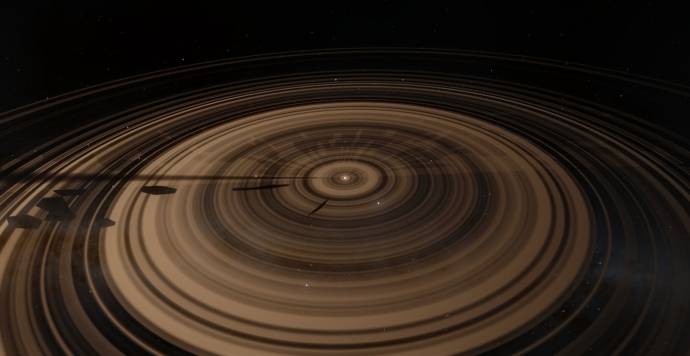
J1407b is not a singular example of a ring system this size around one planet. Tabby’s Star (denominated KIC 8462852) goes through similar processes of being eclipsed every two and a half years by something that is supposed to be a ringed planet with a ring system larger than that of J1407b’s. This planet, however, is highly theoretical, though it shows, once again, how strange, mysterious and fascinating the Universe can be. – Roman Alexander
 ASTROPEEPS.COM
Leave a comment