
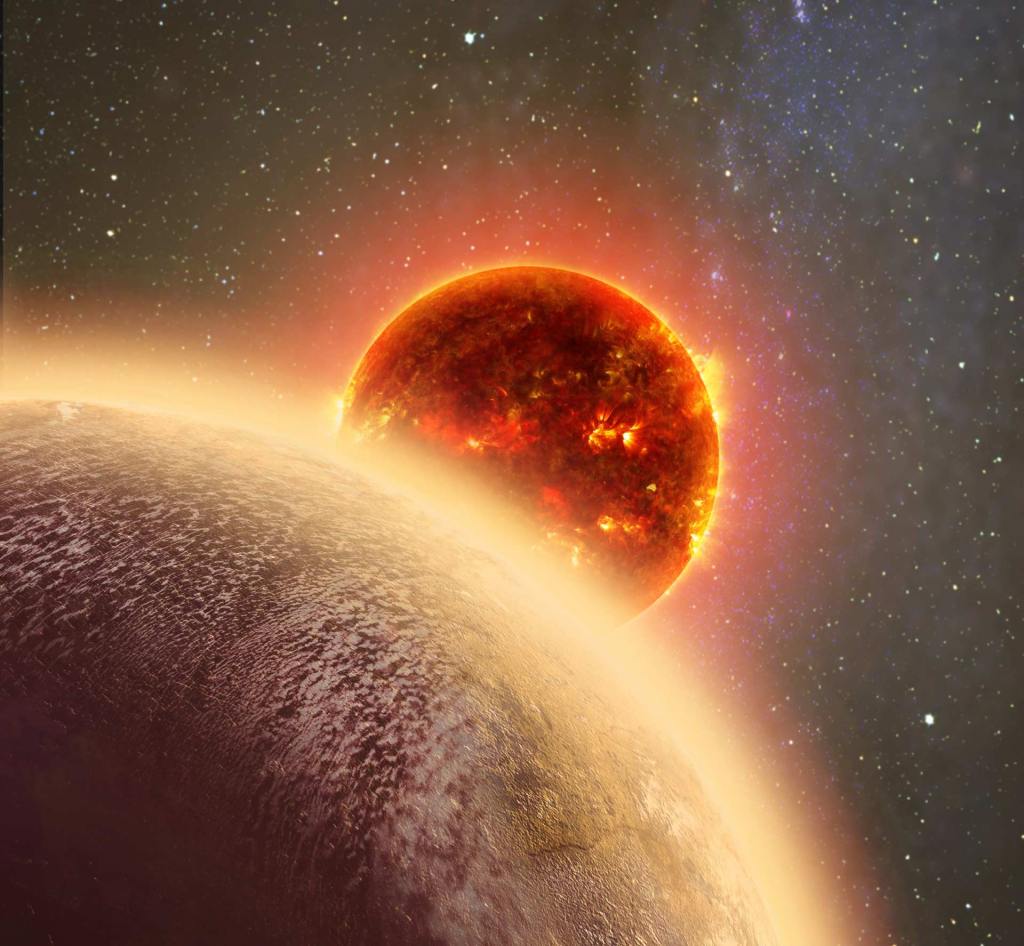
Well, mythological hero Bellerophon used to be regarded as the greatest slayer of monsters. This year, this particular Bellerophon (51 Pegasi b) just slayed a well-deserved Nobel Prize in Physics for its two brilliant discoverers: Michel Mayor and Didier Queloz.
Orbiting around 51 Pegasi, a main-sequence star 50.5 ly away, Pegasi b (formerly known as Bellerophon, currently Dimidium) is the first exoplanet of its kind to be discovered. Though Bellerophone sounded much cooler; in 2015, the International Astronomical Union officially dubbed Pegasi b as Dimidium, meaning half, since the planet is approximately half the mass of Jupiter. Just to clarify, Dimidium isn’t the very first exoplanet to be discovered, it is however the first to be discovered orbiting a main-sequence (Sun-like) star. In fact, the first alleged exoplanets were discovered in 1992 orbiting a pulsar, though the discovery created a big astronomical debate if pulsars could actually be orbited by planets.
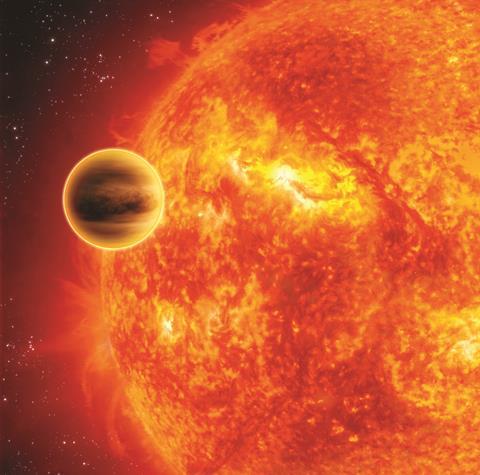
Dimidium is classified as a hot jupiter, orbiting its star, 51 Pegasi, at an incredibly close distance of only 7,7 to 7,9 million kilometers. To put it into perspective, Mercury, the closest planet to the Sun, reaches its perihelion (closest point of orbit) at approximately 46 million km away from our star. Besides reaching scorching temperatures, ranging between 1000C and 1800C, it only takes four days for the Dimidium(/Bellerophon) to complete a full orbit around its parent star, being also in tidal lock to 51 Pegasi.

Dimidium is currently the only known planet to orbit 51 Pegasi, therefore it is denominated with the letter b in its name (51 Pegasi b). If it so happens that other planets will be discovered in this particular star system, their names will follow the order of the Latin alphabet (51 Pegasi c, d etc.).
Finally, although it’s only half the mass of Jupiter, the volume of Dimidium is larger than our own gas giant’s. During the last few years hot jupiters like Dimidium were often discovered. These gas giants orbiting their parent stars at such close range are almost always born far away from their stars, but it only takes them a couple million years (a very short time at an astronomical timescale) to reach such tight orbits where they eventually stabilize. Once a hot jupiter reaches this phase in its lifespan, it starts losing its atmospheres and becomes a Chthonian planets, in other words an ex-gas giant that has lost its gaseous layers. No such objects have been discovered yet, so here’s hoping to new discoveries of new star systems and many more Nobel Prizes in Physics for astronomy.
Wanna know why our own Jupiter didn’t turn into a hot jupiter? Send me an email or ask your question in a comment and I’ll make sure and answer in a brand new article. – Roman Alexander
 ASTROPEEPS.COM
Leave a comment