
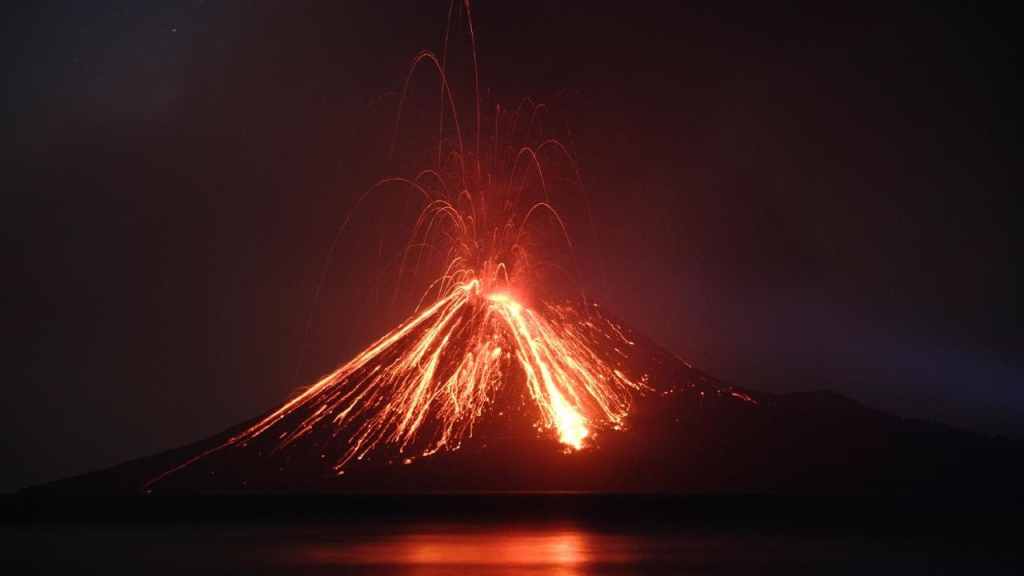
2018 ended in a disaster in one of the most geologically active regions of the world, known as the Pacific “Ring of Fire”, when Anak Krakatau, situated between the Indonesian islands Sumatra and Java erupted and then collapsed into the sea, causing a tsunami that killed 430 people and injuring almost 1500 others.
The Anak Krakatau volcano (meaning the son of Krakatau) is a caldera, as in a cauldron-type hollow resulting from the exhaustion of an underground magma reservoir. It also stands as a vivid proof of how fast our Planet’s landscape can change due to volcanic activity, triggered by tectonic movement.
The Krakatau Island is very young to begin with. Less than 100 years old! The caldera (the underwater/underground magma reservoir) started erupting in 1883, causing one of the most violent eruptions ever recorded by mankind, killing more than 36.000 people. The perpetual lava buildup resulted in an island that emerged from the ocean in 1927, growing on average 5 m/year and reaching an apex of 380 m above sea level in 2017.
On December 22, 2018, Anak Krakatau underwent its most dramatic change to date, erupting so violently that it lost more than 3 quarters (180 million cubic meters) from its total mass, with an entire flank collapsing into the ocean and causing the 2018 Sunda Strait Tsunami. The southwestern sector of the volcano is now completely submerged, leaving only a fragment of the former island above water.
It is expected for the rest of the volcano to collapse into the sea, triggering a second tsunami, this time far less violent than the first one, due to the low mass and height of the remaining caldera.
Let us hope the Indonesian authorities will do everything in their power to prevent the loss of life for the inhabitants of the surrounding islands. – Roman Alexander
The video shows Anak Krakatau erupting in October 2018. (Video credits to: Ronny Quireyns/Volcano Discovery)
 ASTROPEEPS.COM
Leave a comment