
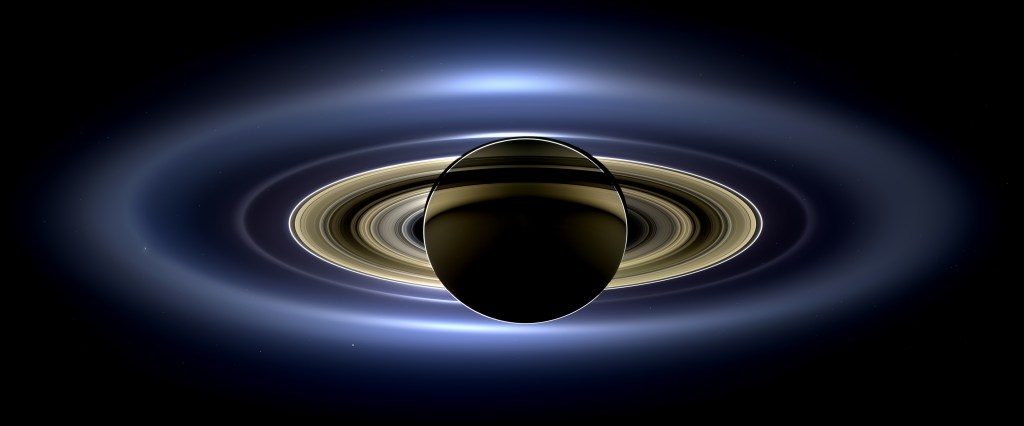
Seems like each time I open my news feed I stumble upon the same subject featured on every possible news channel out there: “Saturn is losing its rings”. So I ask myself (using a very angry Nicki Minaj voice): What gives??!
We’ve known for many years now that Saturn’s rings won’t last forever. God knows why everyone decided to focus on the subject in December 2018. And, by the way, Saturn is only supposed to stop hula hooping with its rings around the Sun in about 100 million years. Not even Sylvester Stallone’s plastic surgeries will last that long! So here’s the deal with Saturn’s rings.
The second largest gas giant is to many the crown jewel in our Solar System, though personally I consider Earth to be the most beautiful and surprising object in our galactic neighborhood.
Saturn’s rings are made mostly of water ice and rocky material ranging from micrometer particles to objects a couple of meters wide.
There are different theories to how and when the rings formed, some suggesting that they are remnants of the original nebular material from when the gas giants formed, while others arguing they are fairly new and resulting from the decay of one of Saturn’s moons due to the strong tidal forces.
One of the most recent theories suggest that the rings formed from the shading of the icy mantle of a massive Titan-sized moon, consisting mostly of water ice, thus explaining why the rings are so poor in rocky material and so rich in ice. Some of the rings consist in ice that is so pure, that they couldn’t be more than 100 million years old. The meteorites colliding with the planet would have altered the purity of the material in time, if the origin was older than 100 million years.
In time, some of the particles forming the rings stick together, forming larger objects, with the natural intention of forming new moons. However, this process is regularly interrupted by Saturn’s immense gravity, blasting this “wannabe” moons apart, to their initial state of small particles.
A couple of month ago, I wrote an article about objects in orbit around larger objects, where I was explaining that these objects are in fact continuously falling, but are kept in orbit because of the centrifugal forces. It might seem to us that these orbits are forever, but in reality, they are just in an extremely slow downfall towards the larger object exerting a gravitational pull.
Same thing with Saturn’s rings, as the material is continuously spiraling down into the gas giant at a flow rate of approximately 5.000 to 45.000 kg/ second, putting an expiration date to the rings in around 100 million years!
Let’s say humanity will still exist by than! Is this the end? Will Saturn become a boring giant circling the Sun? Not necessarily! It might just happen that some other massive cosmic object (including one of Saturn’s moons) will get ripped apart by tidal forces, creating a whole new set of rings! So stay tuned, eat your veggies and be healthy if you want to catch the formation of the new rings in about 100 to 150 million years from now! – Roman Alexander

 ASTROPEEPS.COM
Leave a comment