For a rainbow to appear, we need a couple of ingredients. First, we need sunlight and water droplets suspended in the air. Oh, also someone with a set of eyes to actually see it! In the absence of water droplets, we can do with mist of water (basically water droplets on vegan diet). In order to see the rainbow, we need to have the sun at our back, low in the sky, and the rainbow in front of us. We encounter a variation of conditions for these beautiful phenomena to appear: the atmosphere after rainfall, a waterfall (with the girls from TLC dancing to Don’t Go Chasing Waterfalls), a sprinkler and so on.
But, in all seriousness, a rainbow is a dispersion of light and proof that light itself is composed of wavelengths, each one being associated with a different color. When the atmosphere is moist, each water droplet acts like a small prism dispersing the light from the sun into wavelengths. Yet rainbows are always curved and they always show their colors in the exact same order, from top to bottom: red, orange, yellow, green, blue and violet (ROYGBV). I’ll explain immediately!
When sunlight hits the water droplet with a slight downward path, it encounters another medium with a different optical density, slowing light down and refracting it. This results in the dispersion of light into a spectrum of colors (just like through a prism). When light exits downwards the water droplets, the visible result is a separation into spectral colors, because the boundaries of the droplets are not parallel to each other. We always find the angle of deviation between sunlight and the refracted rays heading towards our eyes at a 40 to 42 degrees from your line of vision! Because each color has a different wavelength, they’re slowed down and will exit the droplet at different degrees. Red light will exit at 42 degrees in the sky (from your line of vision), while blue light will exit at 40 degrees in the sky (from your line of vision), with all the rest of the colors in between. So when you’re standing with the sun behind your back and with a rainbow in front of you, know that at 42 degrees (from your line of vision), the water droplets only reflect red light, then we go slowly down to 40 degrees through all the rest of the colors till we reach 40 degrees (from your line of vision), where droplets only reflect blue light.

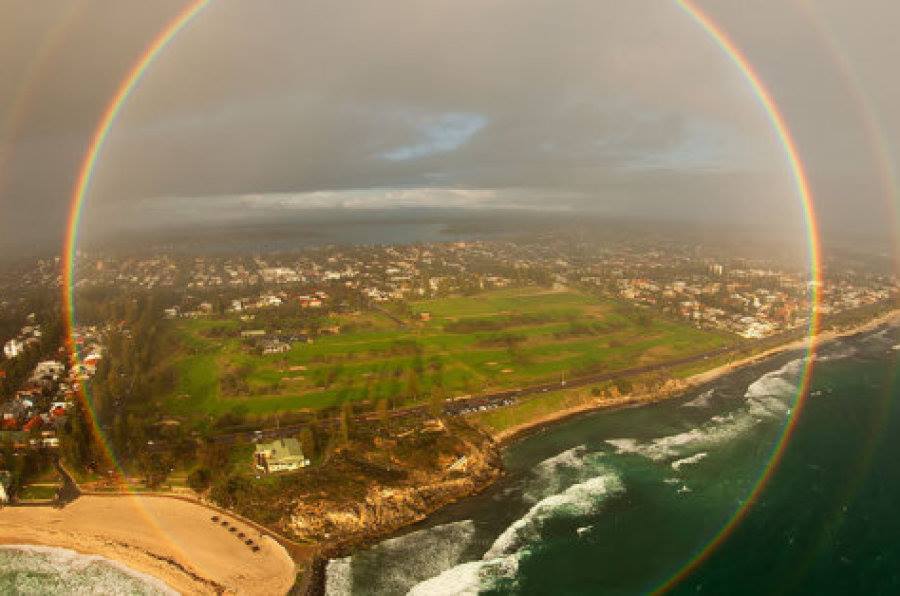
Remember, that all rainbows we see in the sky form a perfect circle, with us always right at the center. You probably understand now why I wrote ‘’from your line of vision’’ so many times. We are a compass, with our vision acting like a compass needle in the sky. We only see half of the circle, because the ground prevents us from seeing the other half. If you are lucky enough to experience a rainbow from an airplane, you’ll be able to see the full circle. You might also experience the full circle rainbow while doing skydiving… that’s, if you’re courageous enough and have a very good bladder! – Roman Alexander
(The question was originally asked by Abir Stitou)
 ASTROPEEPS.COM
Leave a comment