
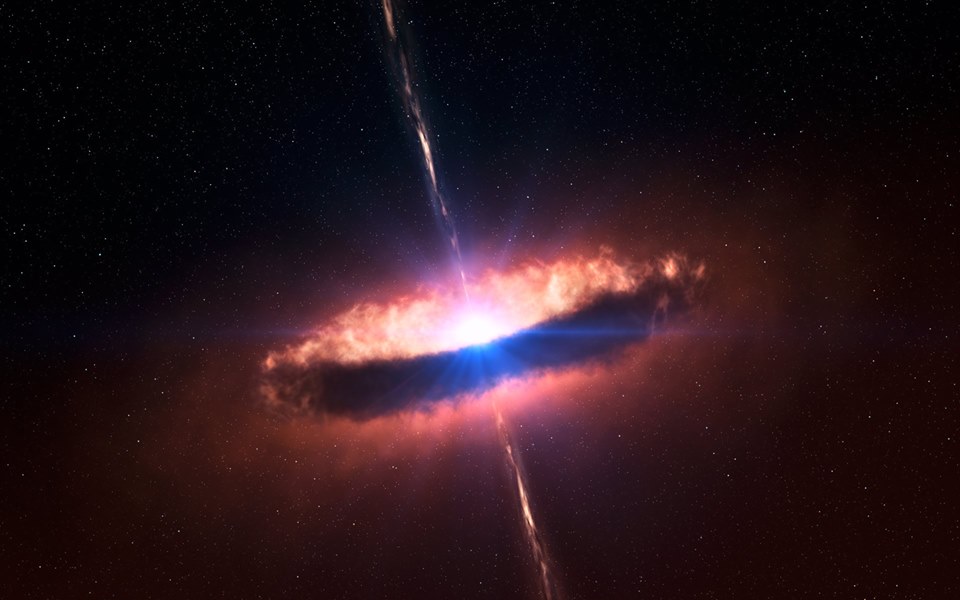
Black holes are like the Kardashians of the Universe, everyone wants to know about them. But, unlike the E! family, black holes are really complicated, not to mention, they don’t really have a linear evolution. Ever since I started publishing on this page, I dedicated several articles about black holes, but there are still so many things about them that were left uncovered by my posts.
The questions asked by Travis Frizzell are very interesting, as they open a brand new chapter about the existence and evolution of black holes. So first, let’s see what’s going on in our own galaxy. The supermassive black hole dominating the Milky Way, Sagittarius A* (Sgr A* from now on) is 3.6 to 4.3 million solar masses (closer to 3.6 million according to recent estimates), with a staggering diameter of approximately one Astronomical Unit (AU), meaning about 150 million km. You would expect something more impressive, but remember, black holes are extremely dense with its entire mass is squeezed inside a subatomic-sized singularity. And if we take the black hole’s accretion disk into account, we can cover a space of about 260 AU. To clarify, the diameter of Neptune’s entire orbit around the Sun is 60 AU.
Still, this gargantuan monster is nothing compared to other black holes. Andromeda’s nucleus (you thought I was gonna say black hole instead of nucleus, but I’m a gentleman) is dominated by a black hole of 110 to 130 million solar masses. Compared to that, our Sgr A* is just a ping pong ball. However, in 1970, astronomers made the first discoveries of TON 618, the largest black hole in the Universe, we know of. TON 618 weighs 66 billion solar masses and no longer fits inside the supermassive category, as it is catalogued as an ultramassive black hole, with a diameter of 5200 AU, and an accretion disk of almost 1 light year in diameter.
TON 618 is pretty much the answer to both questions, as it’s technically a quasar. When black holes swallow to much matter and energy from their accretion disks, they blast electromagnetic radiation, with extreme and enormous power, outshining entire galaxies. The quasars powered by black holes are the single most violent and deadly objects in the entire universe. To give you an example, TON 618 outshines our Sun by 140 TRILLION times. A quasar will eventually die out, but during the life span of a supermassive or ultramassive black hole, it can reignite several times, depending on the amount of matter and energy the black hole will swallow.
Can Sagittarius A* ever become a quasar? Probably not, because it doesn’t seem to have enough material in its accretion disk. But there’s a twist. In about 5 to 7 billion years, during the Milky Way and Andromeda galactic collision, the black hole inside the nucleus of Andromeda will collide with Sgr A* and its accretion disk, resulting in a quasar. Therefore, our own supermassive black hole will be partially responsible for this future energetic burst that will outshine the entire newborn galaxy.
As for the second part of the question, no, quasars do not create new big bangs. Black holes might! In 1964, a Russian cosmologist, Igor Novikov, suggested the existence of white holes as the reverse of black holes. Though white holes are still very unlikely to exist (because none was yet discovered) and purely hypothetical, they offer an explanation to the Big Bang itself, as a supermassive black hole that released all the matter squeezed inside the singularity into a brand new universe. There is a lot of interest manifested lately for the existence of white holes, as they might give us an answer to one of our most intriguing questions: was there anything before the Big Bang? – Roman Alexander
(The question was originally asked by Travis Frizzell from The United States of America)
 ASTROPEEPS.COM
Leave a comment