

I’ll start with the last question. It is very unlikly for the radiation from a supernova to travel through a black hole, first of all because of the black hole’s strong magnetic field (V404 Cygni, a small black hole located 8000ly away from Earth has a magnetic field 500 times stronger than our Sun’s). Also consider that the universe is enormous with light years sepparating stars from one another. So if the radiation from a supernova would actually reach a distant black hole, it wouldn’t be strong enough to affect it in any way. Just to give you an example: imagine you have two grains of sand and you put them 3000km apart from one another. This is more or less the distance and proportions of stars inside a galaxy (obviously not a very accurate one, but it gives you a pretty good insight of how large the cosmos really is).
Now imagine this: for a star to explode into a supernova and create a black hole, it has to have at least 25 solar masses. During the supernova explosion, the collapsing star looses most of its mass. However, the remaining black hole would still have at least 5 solar masses collapsed into an infinitesimal singularity. Imagine our star times 5 squeezed into a subatomic particle so small not even the most powerfull microscope on Earth is able to detect. Now think about the sheer amount of electromagnetism this black hole (singularity + Schwartzchild radius + event horizon + accretion disk) would create. A supernova explosion some light years away from it would be a summer breeze for this cosmic monster.
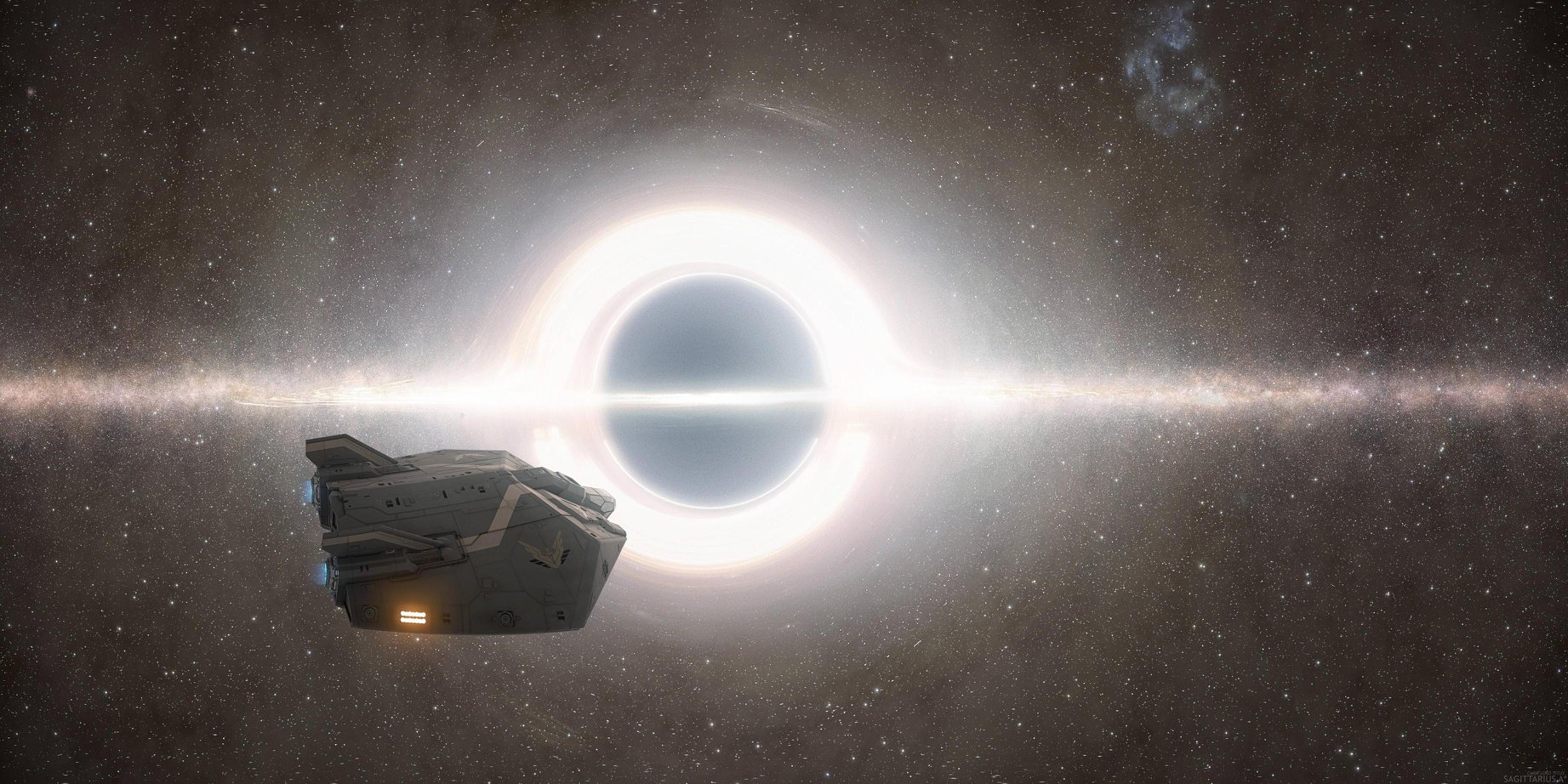
As for the other two questions, it seems tempting to think that we could jump inside a black hole and go through this imaginary portal into a whole new universe where the song Gucci Gang was never released. Personally, I love this idea and I also believe that every black hole creates a brand new universe, mostly because our own universe was created from the Big Bang of a singularity. So, the answer to the first two questions would be: we are on the other side of a black hole that created our universe, while the black holes in our universe are unilateral as we cannot cross to the other side.
However, I have to take our current scientific knowledge into account and tell you that the singularity is the finish line of a black hole. If you fall inside one, your mass would just be added to the total mass of the black hole. I know! I’m a dream killer, or better yet the singularity point of sci-fi dreams. – Roman Alexander
(The question was originally asked by Dave Michaels)
 ASTROPEEPS.COM
Leave a comment