
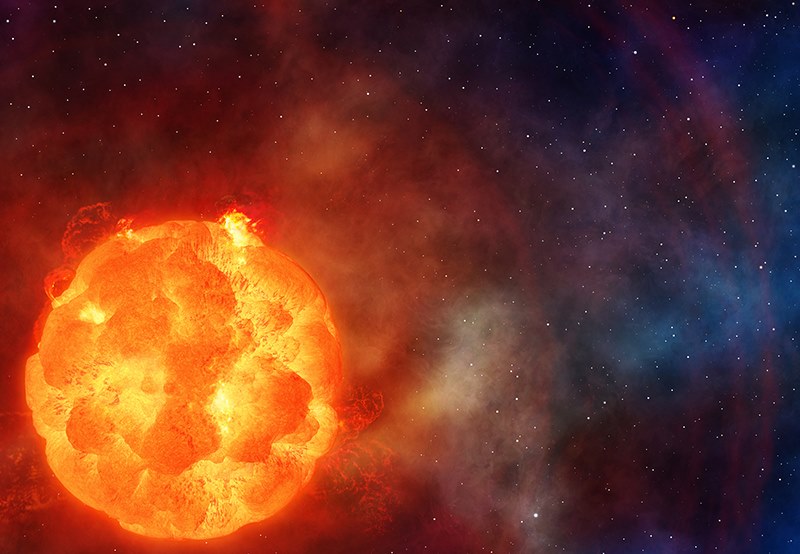
We look amazed at cosmic giants, such as Betelgeuse, that make our star seem like a tiny speck of dust in comparison. But we do, however, misjudge most of these bloated stars, by only considering the volume as an absolute, in relation to our Sun.
Remember, the Sun is a main sequence, 4.5 billion years old yellow dwarf. Lucky us, as we have the chance to be alive through its most stable stage, not to mention that the Sun doesn’t have enough mass to explode into a supernova. Our star has only reached half of its main-sequence stage and will continue its current life cycle for at least 4 billion years more. After its core is depleted of hydrogen gas, the Sun will expand to at least 100 times its current volume, engulfing Mercury and Venus, probably even Earth.
The largest stars we see on the size scales we usually find in books, scientific articles or online are always Betelgeuse, VY Canis Majoris and UY Scuti. And, yes, Betelgeuse (640 ly away from Earth) is one impressive star, with a radius 877 to 955 times the radius of the Sun. It’s hard to picture, so let’s displace Betelgeuse from its Orion Constellation and put it at the center of our Solar System. It would engulf: Mercury, Venus, Earth, Mars, the asteroid belt and Jupiter with all its moons. But how massive is this giant, really? We’ve seen its impressive volume, yet we have to take two more important things into account. First, its mass is 7.7 to 16.6 solar masses. Compare this to its volume, 900 times larger than the Sun and you immediately understand what Betelgeuse really is: a bloated, dying Red Supergiant. Remember, the important word here is dying. Stars the size of Betelgeuse burn through their hydrogen and helium fuel at a very rapid pace. In fact, this 10 million years old star is already burning through its final stage of its life. There is, however something very strange going on with Betelgeuse. It’s losing mass, and nobody seems to understand why. A study published in 2009 showed that Betelgeuse lost 15% of its mass during a period no longer than 16 years, and that the star has at least six atmospheric shells extending to more than 30 AU.
So, when and how will this star die? A couple of years ago, Betelgeuse became somewhat popular in the press as the main trigger for a global apocalypse. It was predicted that the star is about to explode into a deadly supernova, ripping our entire solar system apart. It will never happen. Yes, Betelgeuse is probably at least 10 solar masses, but it’s not even heavy enough to collapse into a black hole. It will however explode into a supernova, becoming one of the brightest objects in the night sky, possibly outshining the Moon for a couple of weeks. Problem is, none of us will get to see it, as the supernova will occur in about 1 million years from now. Will it harm our planet and our great and probably semi-robotic future descendants? Probably not. It’s not heavy enough nor close enough to affect Earth in any way. If it were for Eta Carinae to explode from 640 ly away, it would most probably affect us, as it is a monster star system with at least 300 solar masses. Don’t worry, Eta Carinae will explode in the next 50.000 to 10.000.000 years but it’s located 5000 ly away and will have little effect on Earth… hopefully. Compared to Eta Carinae, Betelgeuse is just a bloated, dying star that will probably give birth to a neutron star after its supernova explosion. – Roman Alexander
(This article is dedicated to Navindra Roopnarine from Trinidad and Tobago)
 ASTROPEEPS.COM
Leave a comment