
Oh, so so many of them! Back in 2014, a study published in Science Magazine suggested that half of all stars in the Universe are rogue stars.
But let’s see first what these rogue stars are, how they form and how they manage to lose their home galaxies.
Rogue stars (also called intergalactic or intercluster stars) are stars that are no longer gravitationally locked to any galaxy; instead they are bound to travel for billions of years in the immeasurable and ever expending space between galaxies, until they burn out their hydrogen or helium gas fuel.
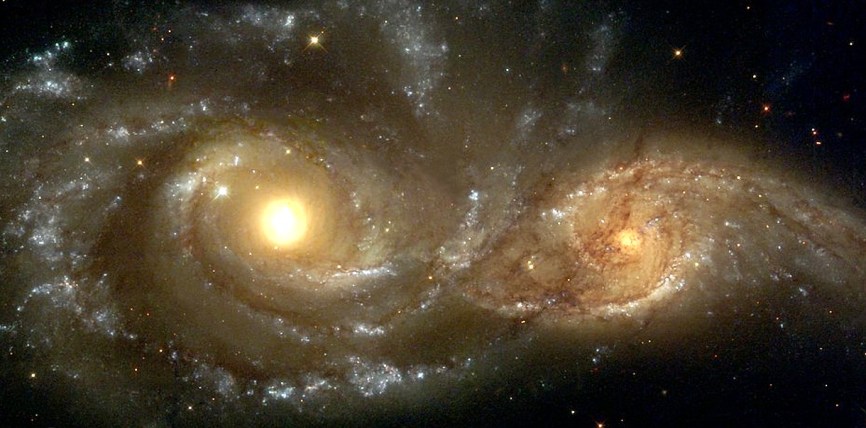
There are some theories to how these stars lose their galactic home, and one of them is intergalactic collisions. Let’s take a scenario that is close to home: the Milky Way. Most of you are huge astronomy fans so you’ve definitely seen the posts, articles and memes about the upcoming collision between Andromeda and our galaxy. Well not exactly upcoming, as it will occur in about 4 billion years. But what some may not know is that the Milky Way doesn’t have to wait for this future giant cosmic collision, as it merges with smaller and dwarf galaxies all the time. In fact, our 100.000 to 180.000 light years long galaxy is surrounded by smaller galaxies and dwarf galaxies such as the Large Magellanic Cloud, the Small Magellanic Cloud, the Canis Major Dwarf and many others. In some way, you could say that the Milky Way is an ever growing galaxy, feasting on an abundant cosmic buffet of smaller galaxies. During these collisions (occurring due to the gravitational pull of our galaxy), the gravitational forces can expel some of the stars residing inside the small galaxies.
If we project an image of the Andromeda-Milky Way binary system collision, it is less likely that many stars will be expelled by the gravitational forces during impact, because both galaxies are large. At one point, during the Milkomeda formation, there will be an event that will create a whole lot of rogue stars: the merging of the two supermassive black holes from the two galaxies resulting in such a violent cosmic event, that it will slingshot a great deal of the stars surrounding them out of the galaxy.
Is there any scenario where we might be in danger to lose our galactic home? Will the Sun ever become a rogue star? Well, no! Remember that our Sun resides inside the goldilocks of the Milky Way, not too far, not too close to Sgr A*, therefore, during the Milkomeda collision, our – then – 8.5 billion old star will just be relocated inside the giant newborn galaxy. – Roman Alexander
(The question was originally asked by Navindra Roopnarine from Trinidad and Tobago)
 ASTROPEEPS.COM
Leave a comment