
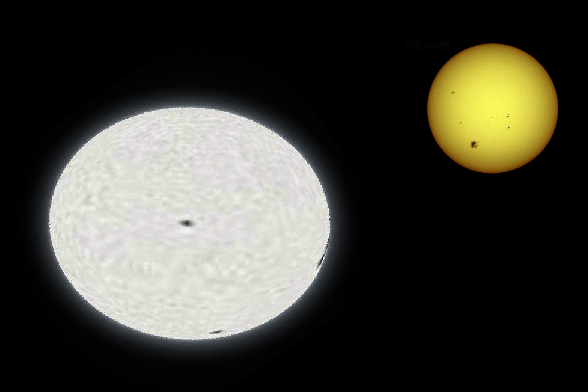
You might have heard about Alpha Lyrae, though all of you most definitely heard about Vega. Well, they’re one and the same. Vega (aka Alpha Lyrae, Alpha Lyr and α Lyr) is the brightest star in the northern hemisphere (following the red giant Arcturus) and is also probably the most studied star in history. At 25 light years away from us and 2.13 solar masses, Alpha Lyrae is not quite like the rest of the stars we’ve observed so far, because – spoiler in the title – it’s shaped like an egg, rather than a sphere.
Vega has a rotational speed so high that it reaches 93% of the maximum velocity before the star would be ripped apart, causing the equator to bulge due to centrifugal force, giving it an oblate look. Furthermore, Vega is very poor in metals, less than 32% than our Sun, although it’s more than twice its mass. Both these anomalies cause the bulging equator of Vega to shine less bright than the poles, giving the impression of a dark stripe surrounding the star, due to a cooler midsection of Alpha Lyrae. It doesn’t mean that Vega is less bright than it should be! On the contrary, it’s inexplicably bright for a star its size and composition. There are many unknowns surrounding this young star (only 200 million years old compared to the Sun’s 4.5 billion) and astronomers are still trying to figure out why Alpha Lyrae seems to head towards spinning self-destruction.
In the meantime, because Vega’s polar surface is pointing towards our northern hemisphere and the average surface temperature is more than 50% higher than our Sun’s, the ‘’egg-shaped star’’ remains one of the brightest stars we see at night. – Roman Alexander
Photo: Vega (blueish white) compared to our (yellow) Sun
 ASTROPEEPS.COM
Leave a comment