

The idea that Earth is at the center of the Universe was self-implied for most prehistoric and protohistoric civilizations.
As a theory, we tend to overlook advanced civilizations such as India with its Vedāṅga Jyotiṣa (or Jyotiṣavedāṅga), dating back to 700 BC, with a background reaching 1400 BC. The Vedic text has little to do with astronomy, though the description of the Sun and the Moon’s motion for ritualistic purposes addresses geocentrism.
The celestial observations recorded by the Babylonians (mostly during Nabonassar 747–733 BC) also imply (without a doubt) that Earth is at the center of the Universe. In fact, Ptolemy (100-170 AD) used many of the calculations dating back to Nabonassar’s period. Aristotle (384-322 BC) before him also believed in a geocentric model like everyone else in the Greek and Hellenistic world. So, to answer one of the questions, we could state Aristotle and Ptolemy to be the first to define Earth’s position at the center of the Universe, though both of them took advantage from a very long historical legacy.
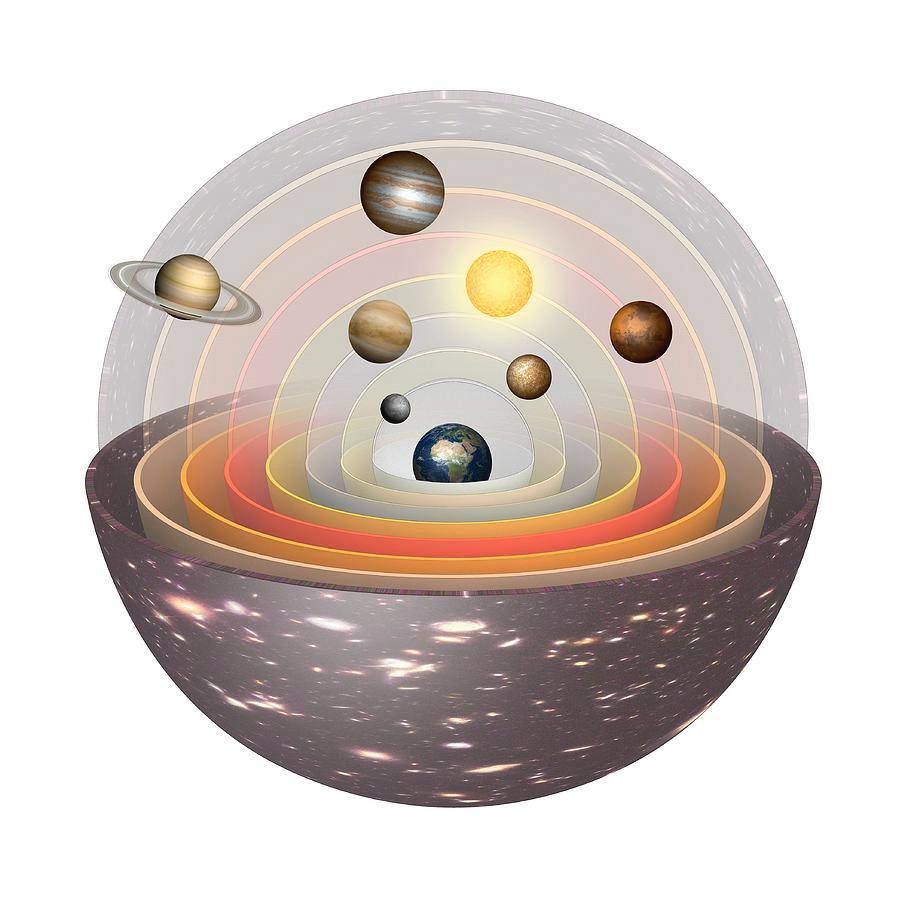
The heliocentric model, placing the Sun at the center of the Universe, was first proposed by Aristarchus of Samos (310 – 230 BC). Most of his works and calculations were lost and his theories were derided and ridiculed for centuries. Almost 17 centuries later, Nicolaus Copernicus (1473 – 1543), a Polish mathematician and astronomer, reinstated the Sun at the center of the Universe, though independently from Aristarchus’ theories. – Roman Alexander
(The question was originally asked by Flordelyn Tulang Joson from The Philippines)
 ASTROPEEPS.COM
Leave a comment