

Let’s assume that for the next 1.5 billion years our planet won’t be hit by a giant asteroid and no world leader will start pushing nuclear buttons.
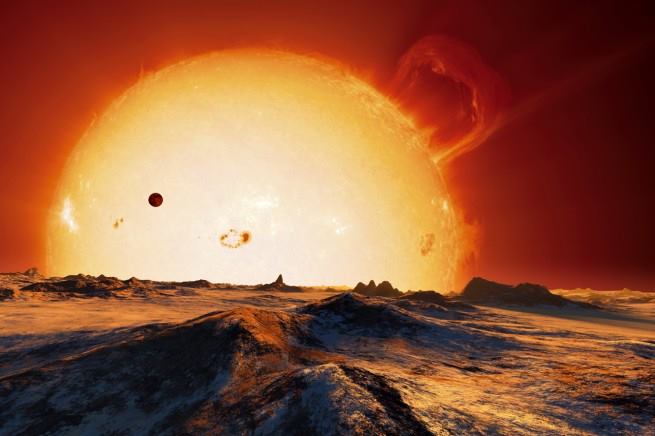
Here is a short timeline of how our planet and the Sun will evolve during the next billion years. Keep in mind that our star is continuously burning through its hydrogen fuel, turning it to helium waste. As a result, the sun is constantly and slowly growing at a stable but ever increasing rate.
Therefore:
• in 110 million years our Sun’s luminosity increases by 1%, thus turning our climate warmer. (The Rolling Stones announce their 257th Farewell Tour!)
• in 320 million years our Sun’s luminosity increases by 5% (climate becomes even hotter, but life is still very much possible).
• in 400 million years the average equatorial temperature is around 38 C (the request for sunscreen lotions skyrockets!).
• in 600 million years photosynthesis starts failing. Surface temperature has now increased by 10 C. (Madonna finally retires from the music industry.)
• in 800 million years, 99% of all life on Earth is already extinct. Multicellular life is no longer possible. Oceans start boiling away.
• in 900 million years Earth’s oceans are completely gone as they have evaporated due to scorching heat of our planet’s surface temperature. (Putin is still president of the Russian Federation.)
• in 1,2 to 1,3 billion years eukaryotes go extinct. The Sun is now 10% brighter. The last remaining life on Earth disappears.
– Roman Alexander
 ASTROPEEPS.COM
Leave a comment