
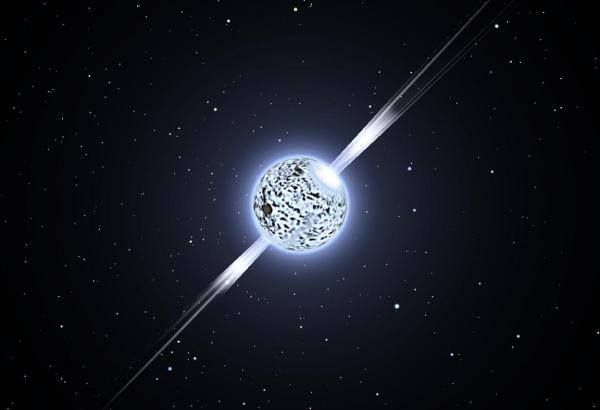
To give you a short answer, a neutron star is the corpse of a collapsed star of at least 8 solar masses. A super dense dead star made of tightly packed neutrons.
When a main-sequence star (at least 8 times larger in mass than our Sun) burns through its hydrogen fuel, it turns into a Super- or Hypergiant (depending on its size and mass). At this point the star continues to fuse its fuel into carbon. A star like our own would end its life at this specific point, turning into a white dwarf made of super heated carbon (most probably diamond). A Supergiant or a Hypergiant has too much mass and pressure, so it continues to fuse carbon into heavier elements, like silicon (mind you, it’s not the same silicone you see in breast implants) and oxygen.
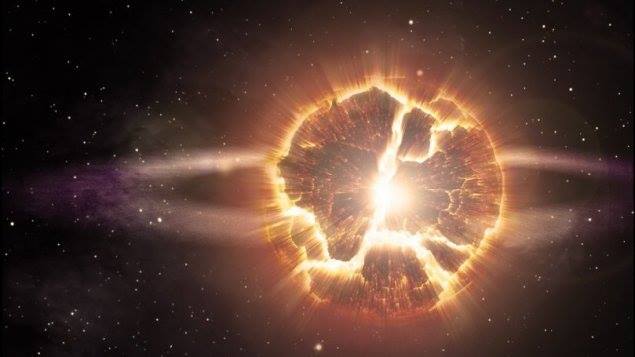
Due to extreme pressures silicon and oxygen continues to fuse into iron. Once this happens, the massive star is doomed to implode and explode into a Supernova (blow its outer layers into a super aggressive cosmic blast). When a star starts fusing silicon and oxygen into iron it becomes a ticking timebomb, with hours or even seconds left to live.
If we picture a star moments before its Supernova explosion, it looks like a layered onion. The outer layers are still made of hydrogen continuing to fuse into helium, the next layer is helium fusing into carbon, the next is carbon into silicon and oxygen and the core is silicon and oxygen fusing into iron.
Iron, however, takes an insane amount of energy to fuse into even heavier elements, so instead of releasing energy, the core starts cannibalizing the entire stars power. The star can no longer sustain nuclear fusion, therefore it explodes into a supernova with its inner layers imploding into a neutron star or a black hole (for a black hole to form, the star needs to be at least 20-25 solar masses).
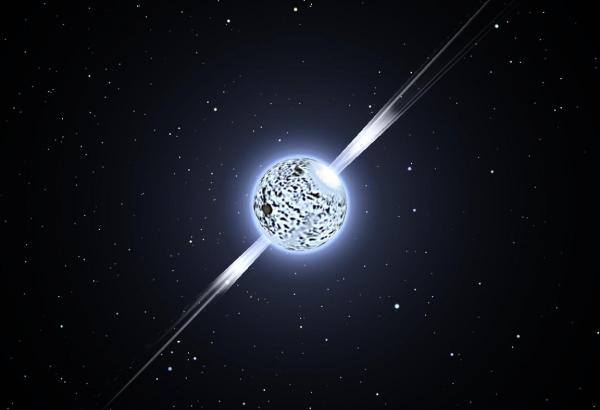
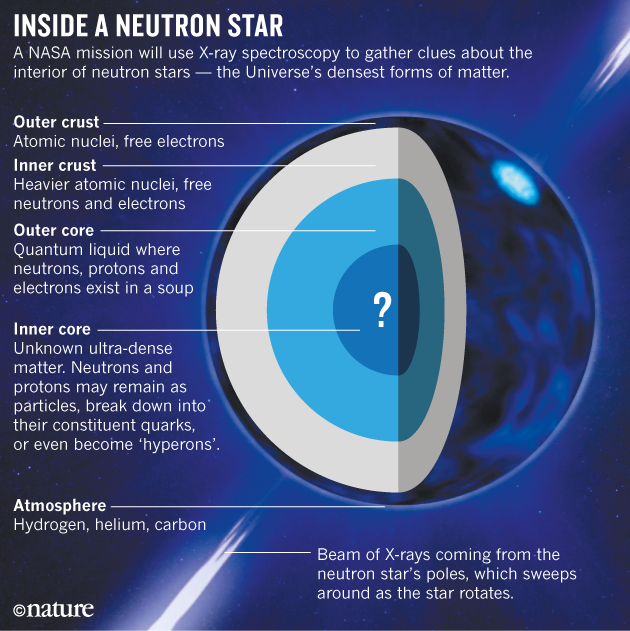
During the supernova explosion what is left is the corpse of the star, the neutron star, with a radius of no more than 10km and the mass of 1.4 to 3 Suns. Its density is so large, that a single teaspoon of matter weighs more than Mount Everest. The neutron star is mostly made out of neutrons that should normally decay, though in the case of a neutron star, the pressure is so large, that they are kept stable. Neutron stars are iron corpses of their ex-Super- or Hypergiants selves, with some amounts of hydrogen and helium pressed by gravity into a very thick and dense atmosphere. In the picture below you can see a theoretical model of the inner composition of a neutron star. These cosmic bodies vary and may come in three forms: regular neutron stars, millisecond pulsating neutron stars (pulsars) and magnetars.
It is suggested that our galaxy alone is host to at least 100 million neutron stars, though most of them are old and cold. – Roman Alexander
(The question was originally asked by Bhuwanesh Singh from India)
 ASTROPEEPS.COM
Leave a comment