This is probably one of the most thought about astronomical subjects at the moment. Do wormholes really exist, and if they do, what do they look like?
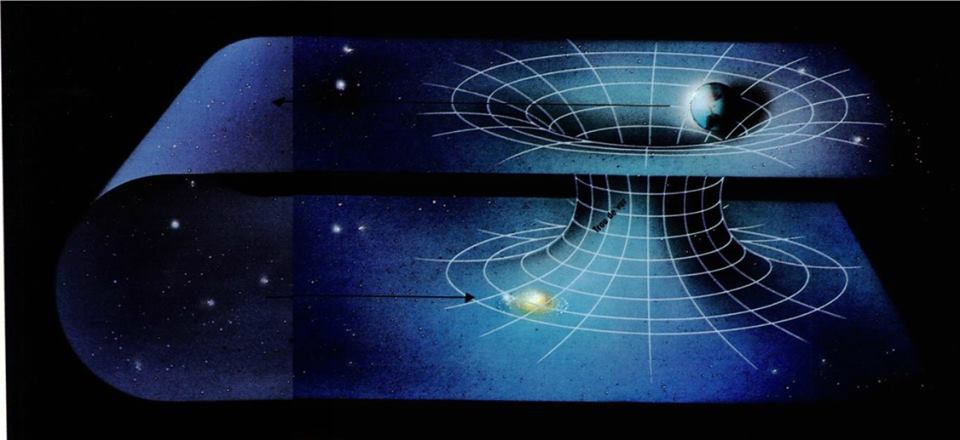
Truth is, there is no actual proof of their existence, nor was a wormhole (a.k.a. an Einstein-Rosen Bridge) ever photographed. Wormholes are still highly hypothetical, but if they do exist they would probably look like a bended sheet of paper. Imagine taking a very long sheet of paper, let’s say 10 km long. Now imagine that you have to walk from one extremity to the other. It would probably take you a couple of hours do so. Now imagine that you bend this very very long sheet of paper with the two ends facing each other and you create a hole from one extremity to the other. Your trip is now shortened to a couple of seconds.
This is the easiest way to imagine a wormhole, but it has one major problem. The sheet of paper theory creates a two dimensional image, and we all know space is three dimensional. So let’s elaborate our initial “sheet of paper” visualization.

In space, a wormhole would look like a funnel (like the one you use in your kitchen to pour water in bottles). This funnel would then be mirrored by another funnel opening somewhere else in the universe or in another universe. It is also possible (but keep in mind: highly theoretical!, because we have no actual proof wormholes actually exist) that a wormhole is in fact a black hole, as the equatorial gravity bulges the sphere opposing the inward tug of gravity and pushing the event horizon away from the singularity, thus creating a wormhole. – Roman Alexander
Photo explanation: An artistic depiction of the Einstein-Rosen Bridge (known as a Wormhole)
(The question was originally asked by Nitin Karthik from Bangalore, India. Nitin, you know I always got your back!)
 ASTROPEEPS.COM
Leave a comment