

As argued by Albert Einstein’s theory of general relativity during the 20th century, the most logical answer would be: nothing. The Universe was created from a singularity containing all the matter in the Cosmos. This singularity was smaller than a subatomic particle and of infinite gravity and mass. Here’s the kicker: time isn’t as regular as we expect it to be. On Earth, time runs slower than on Mars, because Earth’s gravity is stronger by 62%. If we imagine a super-Earth with a gravity twice as strong as our planet’s, time on this super-Earth would run even slower. In this regard, time in the singularity of the origin of our Universe is non-existent because of the infinite gravity. Therefore there can be nothing before the Big Bang, because time before the Big Bang didn’t exist.
But Einstein wasn’t the last scientist of our times, therefore there are many other theories for what preceded the Big Bang.
In 1965, scientists discovered the Cosmic Microwave Background, as in the radiation left over from the Big Bang. The CMB is one of the greatest scientific discoveries in science raising several questions and theories, such as a parent universe that created the Big Bang, or a Big Bang that created a multitude of universes (the multiverse).
Another theory (The Big Bounce Theory) states that the Universe has infinite cycles of Big Bangs and Big Crunches, as in an unending series of expansions from a singularity and collapses into another singularity. Therefore, before this universe, there was another one that collapsed into a singularity and our Universe will eventually collapse into a singularity creating another Big Bang with a brand new expansion.
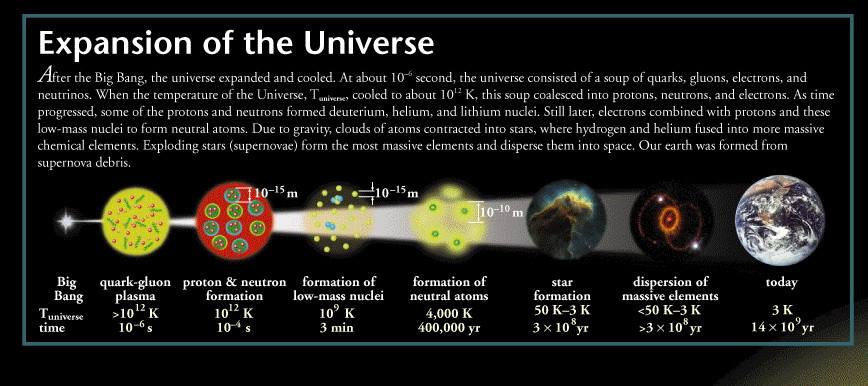
My favorite theory is the White Hole Theory. A White Hole is the complete opposite of a Black Hole. After the ignition of a Black Hole, matter is squeezed inside the singularity and released on the other side as pure energy and radiation creating a Big Bang and a brand new universe. If you think about it, the singularity of a supermassive black hole is similar to the singularity right before the Big Bang: time at a standstill and infinite gravity and pressure. If this theory is correct, then there is an infinite number of universes, each containing trillions of black holes, where each black hole is able to create yet another universe with different amounts of matter.
PS: This subject is extremely complex, so if you, the readers of this post, want to share another scientific theory, write it in a comment or send it in a message and I will gladly publish it. – Roman Alexander
(The question was originally asked by Aaron C Green from Canada)
 ASTROPEEPS.COM
Leave a comment