

Generally speaking, astronomers measure the brightness of a star (accretion disk, galaxy and so on) by measuring the amount of energy it releases. Take the Sun, for instance! At a fixed time, our star releases an astonishing amount of 3,828*10^26 watts, that’s 382.800.000.000.000.000.000.000.000 watts, in other terms L☉ or solar luminosity. In fact, every second, our Sun produces more energy than the entire world in 2017… times 1.000.000!
Now back to luminosity! The brightness of objects in the universe (such as stars, galaxies or accretion disks) are measured in solar luminosities, using the Sun as a standard. To give you an example: the monster star system Eta Carinae has a luminosity 5.000.000 times the solar luminosity!
There are different ways to measure the luminosity of objects, and one of the most accurate way is to determine it from the object’s size and its effective temperature (the latter being estimated from the spectrum). – Roman Alexander
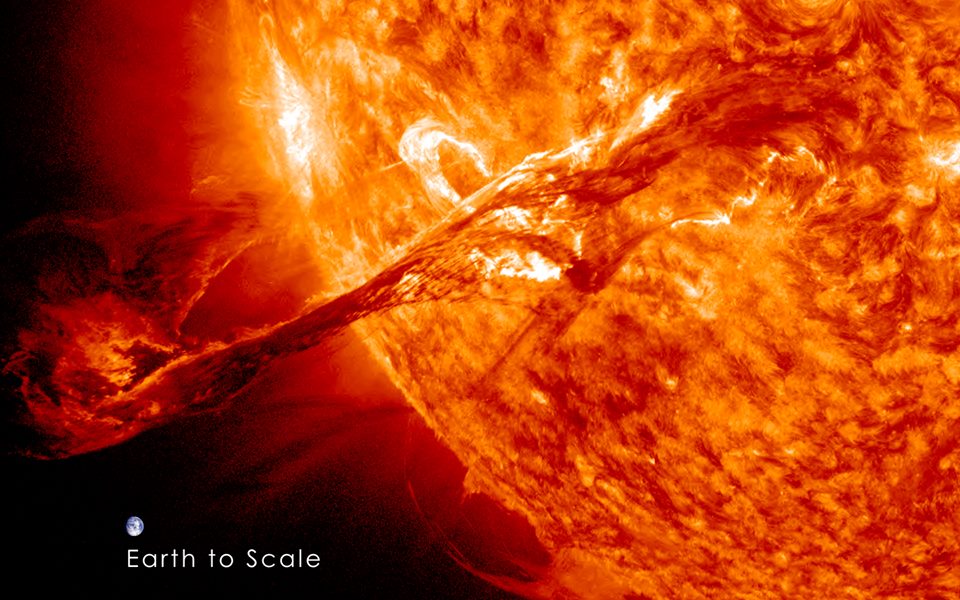
Photo credits: NASA’s STEREO and ESA/NASA’s Soho, shot on August 31, 2012. Composite image with a filament eruption during a CME (coronal mass ejection) of the Sun.
(The question was originally asked by Bhuwanesh Singh from India)
 ASTROPEEPS.COM
Leave a comment