
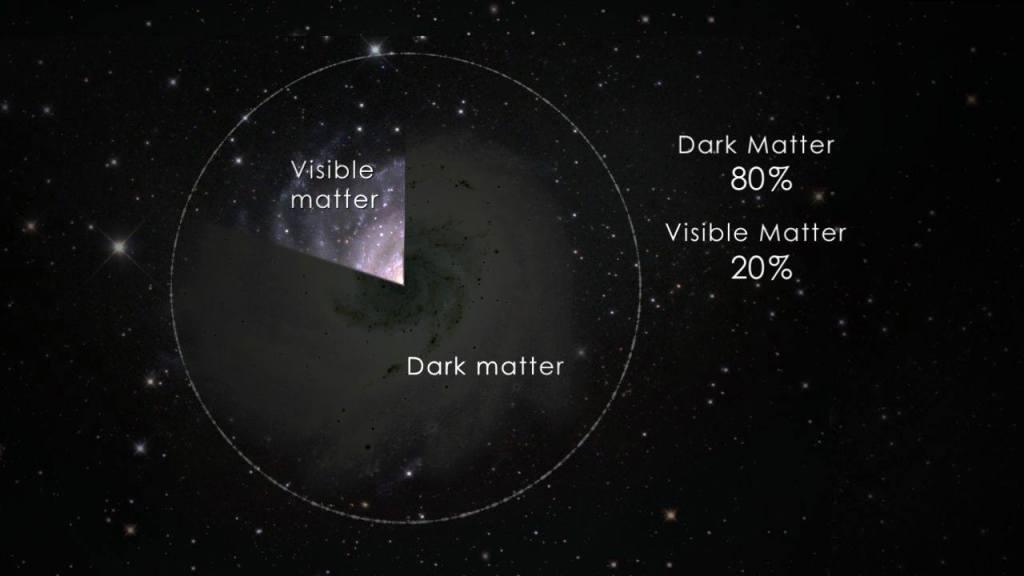
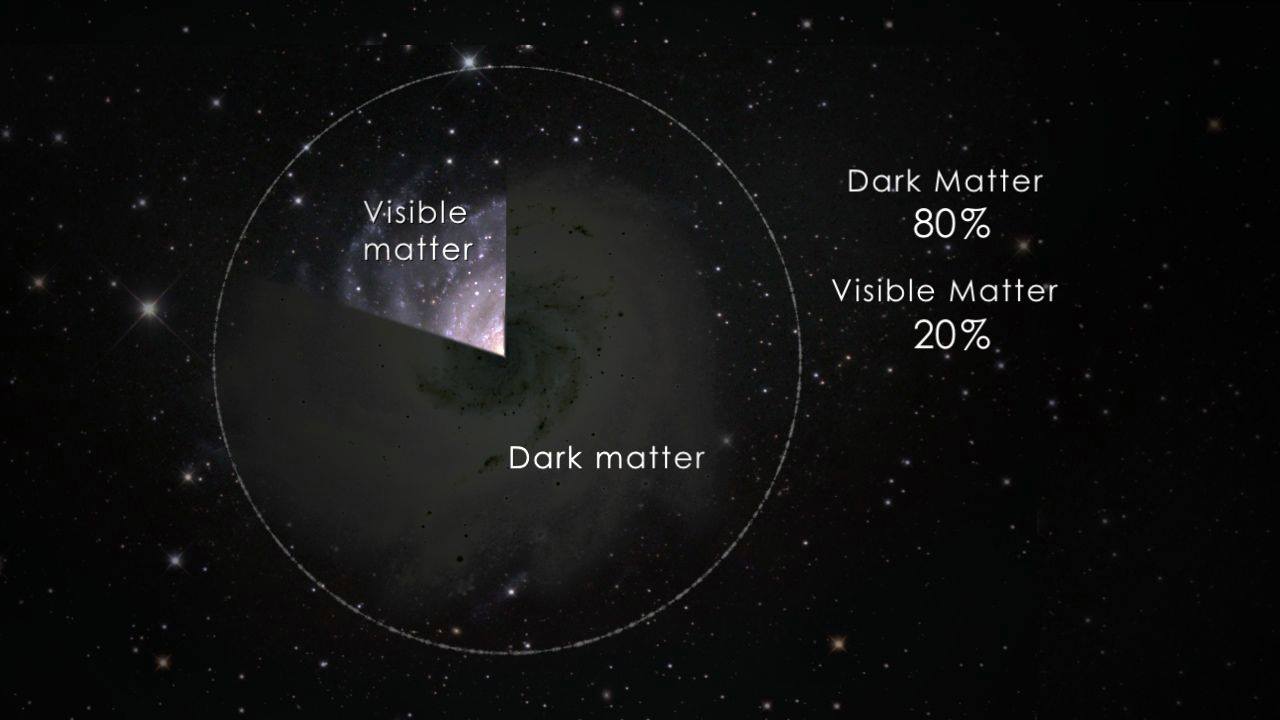
Dark matter accounts for around 80% of all matter in the Universe (the rest being normal matter). The name ‘dark matter’ implies that it is black (or dark) in color, though in reality, we should really call it ‘invisible matter’, due to the fact that it never interacts with any electromagnetic radiation such as light. Dark matter does not appear among the elementary particles that we know of.
So how do we know it’s there? We know, because it interacts with visible matter on a gravitational scale. Dark matter has mass, therefore it produces a gravitational effect. To give you an example: we assume galaxies orbit around supermassive black holes. Let’s take the Milky Way for example. Our 100.000 light years wide galaxy orbits around Sagittarius A*. Computer simulations and other astronomical calculations have failed to prove that Sagittarius A* is gravitationally powerful enough to keep our galaxy together. If dark matter didn’t exist, the Milky Way would break apart and lose it’s outer layers into intergalactic space. Scientists have concluded that there must be something else out there interacting with the normal matter of galaxies, keeping them in place. So, to answer your question, no one has ever seen or observed dark matter, because it doesn’t interact with light, therefore it is invisible to our telescopes. There isn’t really a technique for us to detect dark matter, besides its gravitational effects on normal matter. – Roman Alexander
(The question was originally asked by Bhuwanesh Singh from India)
 ASTROPEEPS.COM
Leave a comment