

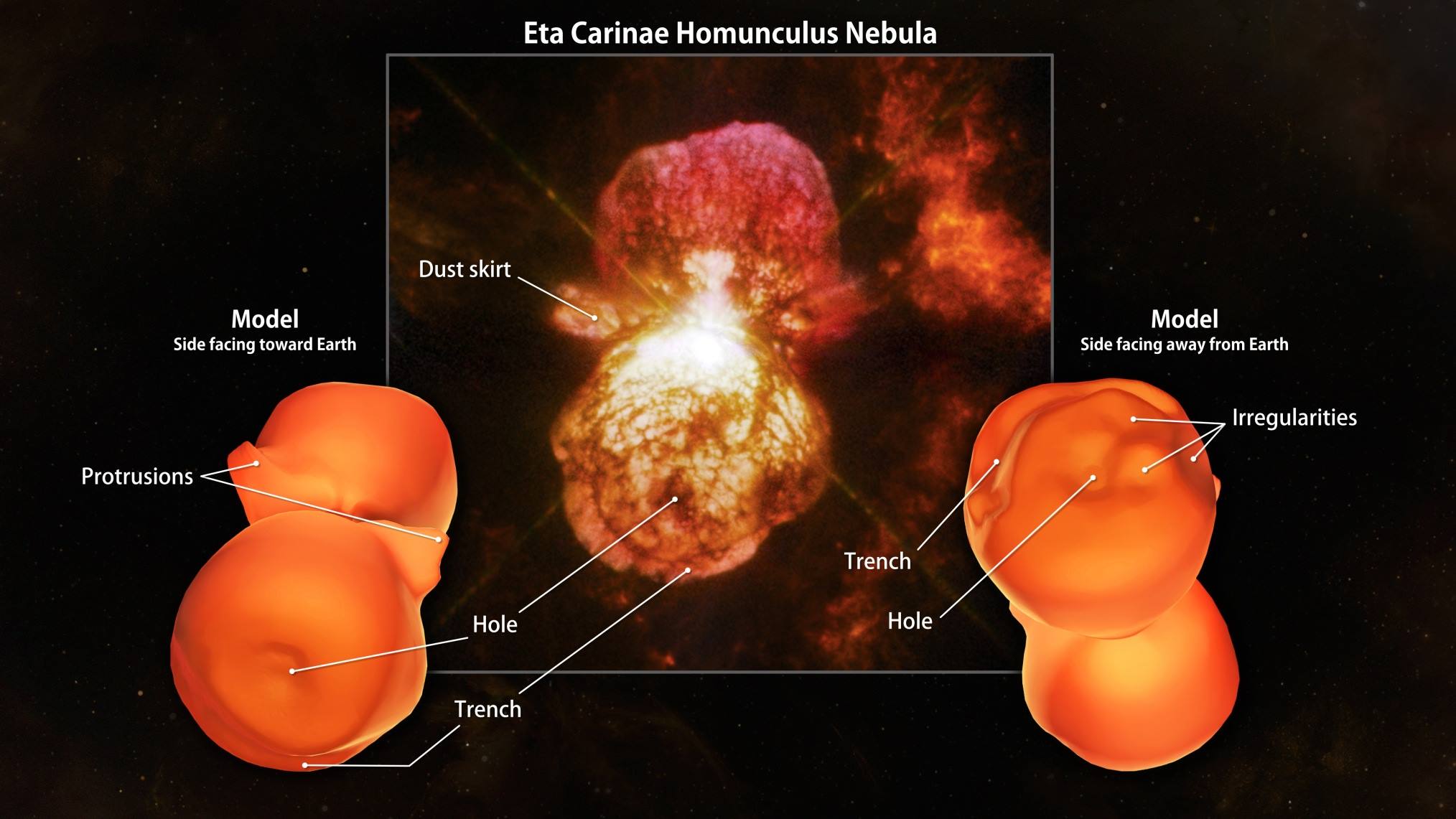
This one is more than just one star, it’s a star system composed of two massive stars: η Carinae A and η Carinae B (denominated from now on as Car A and Car B), surrounded by the Homunculus Nebula, within the gigantic Carina Nebula, measuring 50 light years across, 7500 light years away from our planet.
The Eta Carinae Star System is unparalleled in our Milky Way, according to astronomic observations leading to today. Its two supermassive stars both exceed the minimum size for a supernova explosion. Car A is between 150 and 250 solar masses, with a 100 to 800 solar radii, while Car B is between 30 and 80 solar masses with 14 to 24 solar radii. The stars complete an eccentric orbit around each other in 5,54 years with a maximum distance between them of 15,4 AU.
The star (star system to be precise) was first catalogued in 1677 by Edmond Halley and became notorious for its very active and violent behavior. By the middle of the 19th century, the star became the second brightest star in the night sky for around two decades due to a false supernova, when Car A ejected at least 10% of its total mass in a huge peanut shaped nebula surrounding the two orbiting stars, known as the Homunculus Nebula. The event is known as the Great Eruption.
The behavior of the two stars may be explained by their rapid burning rate and the transition from one type of fuel to another due to atomic fusion.
We have no idea when this star will actually explode in a supernova. Most astronomers agree that Eta Carinae is closing in towards its spectacular and frightening death, though there are still some who say that the star is just at the beginning of a ten million years life cycle.
Truth is we don’t even know if the star still exists or if it has already exploded into a supernova, because we see its 7500 year old image through our telescopes.
The supernova explosion is of high interest, as there are different opinions to what will happen to our planet if the radiation will hit Earth.
The alarmists say that it will completely devastate our atmosphere and terminate all life on Earth. Very unlikely!
Most astronomers say that the radiation from the supernova will miss Earth entirely, but if it will hit the planet, it will have little affect on it. Parts of the ozone layer will be stripped away and our artificial satellites will be damaged, but no harm will come to life on Earth. Since Eta Carinae is 7500 light years away, it’s very likely that the radiation will be to weak when it reaches Earth to do any damage at all! Regardless, if we do have the chance to witness the supernova of Eta Carinae, it will appear as bright as the Moon in the night sky for a brief period of time.
As for the planets in close proximity to Eta Carinae, they will be completely destroyed by the supernova explosion! – Roman Alexander
 ASTROPEEPS.COM
Leave a comment