
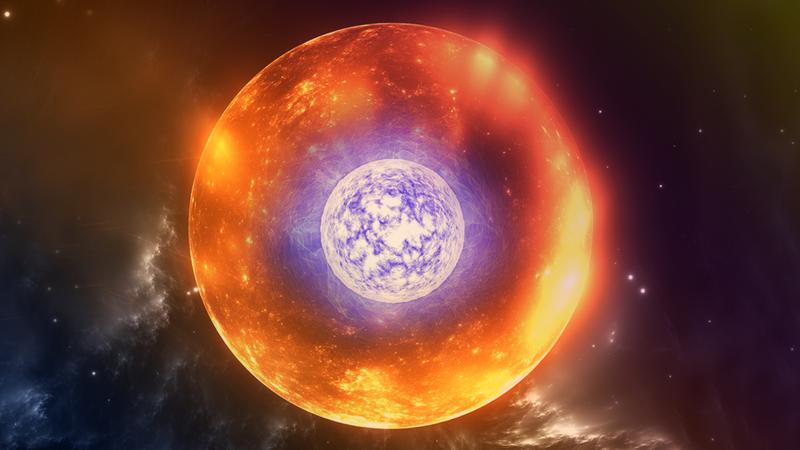
Thinking about strange, violent and extremely dangerous cosmic objects, some candidates come to mind like a Red Giant or a neutron star. Put these two together and you get a cosmic nightmare, just like HV 2112, a Thorne-Zytkow object (cannibal star), inside the Small Magellanic Cloud, in the Tucana Constellation, 200.000 light years away from Earth.
A Thorne-Zytkow object (TZO) is a neutron star residing within a Red Giant or inside a Super Giant. These object are supposedly born after the collision between a neutron star and the giant. When the neutron star enters the outer layers of the Super Giant, the core of the Giant and the neutron star start spiraling in a decaying orbit resulting in a final deadly collision between the two into a black hole. In case of a Red Giant, if the core of the cannibalized star isn’t large enough, the collision between the core and the neutron star will result in another neutron star (though very unlikely).
These objects were hypothesized during the late ’70 by astronomers Kip Thorne and Anna Zytkow, with small chances of ever proving these type of stars could actually exists. Till 2014, that is, when HV 2112, a variable star first discovered in 1908, became a very strong candidate for a Thorne-Zytkow object (TZO). Why? Because the star contains high amounts of lithium, rubidium and molybdenum, a unique signature of Thorne-Zytkow objects.
Debates for HV 2112 as a TZO are still open, as there are some characteristics that might define the star as a binary system or an asymptotic giant branch star, a red giant during its last stages of evolution.
Regardless, if HV 2112 is in fact a TZO, by the time you read this post, the star is already a black hole, since the orbit between the neutron star and the core of the red giant decays in just a couple of centuries, and HV 2112 is 200.000 light years away from our telescopes. – Roman Alexander
 ASTROPEEPS.COM
Leave a comment